• Home
  • Start Here
  • Podcast
  • Thinking Bigly
  • Investing
  • Arts
    • Contact/Donate
    • Sign Up
    • Search
    • Privacy
    • Disclaimer
    • Arts
    • Investing
    • Newsletter
    • Theatre
    • Poetics
    • India (1997)
    • Indonesia (1998)
    • Popular
    • Blogs
    • Food
    • Photography
    • Personal
    • Mingle
    • Writer Bio
    • Investor Bio
    • Me
    • Yellow Gentlemen
    • Investment Aphorisms
    • Places in Between
    • Grants
    • Angel Investing
    • Shop
    • Unconference
Menu

Then Do Better

Street Address
City, State, Zip
Phone Number

Your Custom Text Here

Then Do Better

  • Home
  • Start Here
  • Podcast
  • Thinking Bigly
  • Investing
  • Arts
  • Support
    • Contact/Donate
    • Sign Up
    • Search
    • Privacy
    • Disclaimer
  • Archive
    • Arts
    • Investing
    • Newsletter
    • Theatre
    • Poetics
    • India (1997)
    • Indonesia (1998)
  • Blogs
    • Popular
    • Blogs
    • Food
    • Photography
    • Personal
  • About
    • Mingle
    • Writer Bio
    • Investor Bio
    • Me
    • Yellow Gentlemen
    • Investment Aphorisms
    • Places in Between
    • Grants
    • Angel Investing
    • Shop
    • Unconference

Shell CEO defending its climate policy alignment

September 14, 2019 Ben Yeoh
public.jpeg

“I had an ambition to be a synchronised swimmer…”  Adam Matthews (Church of England) challenges Shell CEO Ben van Beurden on how ambition translates into reality and “mean what we say”.  

Shell CEO (pictured) explains the full life cycle measure of Net Carbon Footprint (includes use of product [carbon scope 3] and Shell’s ambition. Need to be 50% less in Shell’s portfolio by 2050 to hit climate ambitions (Paris alignment).

This is derived from a fairly technical view - you can find Shell’s explanation here.

public.jpeg

A few elements of Shell’s plan:

-Links targets to remuneration

-public commitments to net carbon target 

-annual review of progress 

-TCFD alignment 

-review of lobby practices 

One can argue with Shell’s position but I do think it’s worth taking the time to understand where it is coming from.

public.jpeg

Bending the demand side has been considered hard for companies to do - but they are also uniquely placed to influence government policy and consumer behaviour.

It is worth getting your head around “scope 3” carbon emissions.

public.jpeg

There are many factors in play. The one which is high in my mind is the need for more innovation not less. You can see from above chart that arguable government spending here is under invested and similar arguments could be made for the private sector.

Short blog on there here.

In Carbon, ESG, Investing Tags Climate, Policy

Stakeholder Capitalism

August 22, 2019 Ben Yeoh
public.jpeg

–Why recent stakeholder capitalism statement isn’t very radical

–Why Milton Friedman would mostly approve

–Cliff Asness partial defence of imperfect shareholder value (cf. James Montier on world’s dumbest idea)

–How pie growing strategies are good for all stakeholders

–The importance of extra-financial capitals, such as Tyler Cowen’s weighting to the environment

–Why  intersubjective myths and innovation are important.  


Much fanfare is being made of a recent announcement by a group of CEOs about looking after more “stakeholders” than simply shareholders. A stakeholder capitalism. This idea is very old.


As written I don’t think it’s much more different from the flavour of capitalism we have been dealing with for a few decades (perhaps a touch less than some aspects of extreme neo-liberalism). It’s not the radical re-imagining that the populist left or right are hinting at.


Take the Credo as laid out by healthcare company, Johnson and Johnson:


We believe our first responsibility is to the patients, doctors and nurses, to mothers and fathers and all others who use our products and services. In meeting their needs everything we do must be of high quality. We must constantly strive to provide value, reduce our costs and maintain reasonable prices. Customers' orders must be serviced promptly and accurately. Our business partners must have an opportunity to make a fair profit.

We are responsible to our employees who work with us throughout the world. We must provide an inclusive work environment where each person must be considered as an individual. We must respect their diversity and dignity and recognize their merit. They must have a sense of security, fulfillment and purpose in their jobs. Compensation must be fair and adequate and working conditions clean, orderly and safe. We must support the health and well-being of our employees and help them fulfill their family and other personal responsibilities. Employees must feel free to make suggestions and complaints. There must be equal opportunity for employment, development and advancement for those qualified. We must provide highly capable leaders and their actions must be just and ethical.

We are responsible to the communities in which we live and work and to the world community as well. We must help people be healthier by supporting better access and care in more places around the world. We must be good citizens — support good works and charities, better health and education, and bear our fair share of taxes. We must maintain in good order the property we are privileged to use, protecting the environment and natural resources.

Our final responsibility is to our stockholders. Business must make a sound profit. We must experiment with new ideas. Research must be carried on, innovative programs developed, investments made for the future and mistakes paid for. New equipment must be purchased, new facilities provided and new products launched. Reserves must be created to provide for adverse times. When we operate according to these principles, the stockholders should realize a fair return.

Yet this is not that far away from what Friedman - one of the most prominent free market thinkers - wrote in his famous 1970 NYT op-Ed essay and points he makes in Freedom and Capitalism (link end).  


Friedman writes:


“...it may well be in the long-run interest of a corporation that is a major employer in a small community to devote resources to providing amenities to that community or to improving its government. That may make it easier to attract desirable employees, it may reduce the wage bill or lessen losses from pilferage and sabotage or have other worthwhile effects….”

Milton Friedman would promote activity that leads to corporate profits – eg investing in employees, customer service, supply chain etc.  as a route to profits.


It turns out at the same time I was having this thought, Chicago finance professor, Luigi Zingales was having a similar thought (his washington op-ed end), although more critical as move of “corporate capture” / marketing.


As long time readers will know, I support the idea (or as I’m starting to call it more often the intersubjective myth cf. Harari) of growing “extra-financial” forms of capital – such as human capital, social, relationship, intellectual and environmental (some times falling under the heading of ESG = Environment Social Governance).


But oft times overlooked is Friedman’s critique on the trade-offs of those capitals  – but echoed by AQR’s Cliff Asness (quantitative investor (very successful), typically free market advocate) critique – is that the trade-offs between stakeholders eg employees vs customers vs suppliers vs environmental is difficult. 

 (Asness takes a good swipe at James Montier now of GMO, who writes in an entertaining piece about Shareholder Value as being a dumb idea - see links end. Montier end up advocating for a form of stakeholder view - in that concentrate on the customer and shareholder value will follow - but one can argue that is a shareholder value maximisation strategy as you can only reach shareholder value by an oblique fashion in any case - cf. John Kay)

On twitter, Asness makes a comment that “woke sells” (eg in the case of Nike, it really does).


Under this model (Long-term) profits or perhaps long-term share prices are a market way of discovering, incentivizing or elucidating those trade offs. Share price - in particular short term share price - has been criticised for a long time as not being a proxy for “long term value creation” - this straddles Lyn Stout’s critique in this (although Stout adds in legal philosophy about if a US Corp is a “legal person” and thus not owned by shareholders - I’m not convinced by this argument as owning 51% of a company pretty much does allow you to direct a company how you wish - though in atomised ownership a lot is delegated to directors and management).


Zingales himself examines this question with a paper suggestive of maximizing shareholder welfare over market value.


How do you trade-off between employees and suppliers? If you paid both or either to maximise their value, there would be no business. Same for maximising customer value.  Also (and Stout recognises this), employees are also shareholders and customers etc.


The ideas that B-corp has around this are a touch more radical approach. They measure impacts across other stakeholder domains. But in the end they still simply give a certain amount of points to certain actions (eg subsidised childcare =0.7 points) and then add them up - over 80 points = B-corps certified.


Other academics, such as LBS’ Prof. Alex Edmans advocates and demonstrates that “pie growing” strategies are still excellent strategies for growing all stakeholder wealth (perhaps environmental capital is left out of this notion) although there are imperfections (see end for lecture series).


Still the business round table statement as actually expressed is uncontroversial and is not – in my view – a very different flavor of capitalism. The statement also is tangential on environmental capital (via communities the statement “protects the environment”, which was one of the important long-term points made by Tyler Cowen in his philosophical treatise: Stubborn Attachments. Thus the externality / tragedy of the commons problem is potentially unresolved.


I quote the statement:


“…While each of our individual companies serves its own corporate purpose, we share a fundamental commitment to all of our stakeholders.


We commit to:

- Delivering value to our customers. We will further the tradition of American companies leading the way in meeting or exceeding customer expectations.

- Investing in our employees. This starts with compensating them fairly and providing important benefits. It also includes supporting them through training and education that help develop new skills for a rapidly changing world. We foster diversity and inclusion, dignity and respect.

- Dealing fairly and ethically with our suppliers. We are dedicated to serving as good partners to the other companies, large and small, that help us meet our missions.

- Supporting the communities in which we work. We respect the people in our communities and protect the environment by embracing sustainable practices across our businesses.

- Generating long-term value for shareholders, who provide the capital that allows companies to invest, grow and innovate. We are committed to transparency and effective engagement with shareholders.


Each of our stakeholders is essential. We commit to deliver value to all of them, for the future success of our companies, our communities and our country.”


The reflection I’ve picked up from thinkers on capitalism about 200 years ago is how the design of markets was thought to try and keep humans away from more damaging impulses. 


Albert Hirschman investigates this in his eloquent treatise “The Passions and the Interests”.


The case is made that capitalism would activate benign human actions at the expense of malignant ones.


Nobel Laureate, and developmental economist, Amryta Sen makes the analogy:

“The basic idea is one of compelling simplicity. To use an analogy (in a classic Hollywood form), consider a situation in which you are being chased by murderous bigots who passionately dislike something about you—the color of your skin, the look of your nose, the nature of your faith, or whatever. As they zero in on you, you throw some money around as you flee, and each of them gets down to the serious business of individually collecting the notes. As you escape, you may be impressed by your own good luck that the thugs have such benign self-interest, but the universalizing theorist would also note that this is only an example—a crude example—of the general phenomenon of violent passion being subdued by innocuous interest in acquiring wealth. The applause is for capitalism as seen by its pioneering defenders….”

Putting this together, leads me to reflect perhaps as many thinkers have suggested we need a better measurement of “wealth” which is beyond GDP. And beyond short-term profits / share prices. But long-run value creation as imperfectly measured by share prices, does capture imperfectly, trade-offs between stakeholders - and most business managers understand that - to increase long run share prices managers eg. invent new useful products for people that takes engaged employees spending time and money in research.


Still moving beyond long-run GDP and long run stock would be helpful if we can add other dimensions of wealth successfully. Again Cowen and others have been suggesting this for a while and there are thinkers working on, for instance, natural capital value. Freedom to work and not be subject to slavery is another form of “wealth” captured elsewhere in our society. (I reflect that historic progressives thought children had a right to work.)


However thinking about the value of other capitals and assets. It’s a hard problem. As I reflected on my journey through the Indonesia jungle – what price running water? What price our rain forests ?


As alluded to in Ray Dalio’s critique of our current late capitalism (and socialism) is that socialism is not very good at growing the pie it seems, but Dalio would argue capitalism is not very good at splitting the pie.


I don’t have an answer to that. (No surprises as if I did, I should be doing some thing very much different with my life). But I have two factors to throw into the mix.


First, it’s the power of stories and our cultural myth narratives. These have the power to dramatically alter our value of different capitals / assets / liabilities. I have mentioned several items on this. I am particularly fond of the examples of how the British banned slavery and on the colour pink (it was not so emphatically a girl’s colour until relatively recently).


Slaves have enormous economic/financial value (and slave-owners were paid off in the battle to ban slavery) but the changing cultural narrative put a heavy “discount” on that value.


If you look back to the code of Harumbi – the ancient law code


“The Code of Hammurabi is a well-preserved Babylonian code of law of ancient Mesopotamia, dated back to about 1754 BC. It is one of the oldest deciphered writings of significant length in the world.”


The Code explicitly values the lives of different types of humans (slaves, non-slaves, elite) in different amounts of silver and different punishments for the different classes. And there are official and unofficial codes today that do similar valuations. For instance, the recent ability for women to drive in Saudi Arabia or permission for marriage etc.


These codes are currently being fought in culture and identity wars. In history, these would have been fought with obvious killing weapons and empires. Today, the weapons are more varied and include cyber and social media warfare. The rules of engagement are less clear.


Second, is the optionality of “innovation” combined with the power of free individuals. The world can be more free, and there can be more innovation. That combination could be unexpectedly great.


These are two items I discuss in my performance-show Thinking Bigly and I am still dwelling on. If you are in London – Do come 13 / 14 November.


Details on Thinking Bigly: https://www.thendobetter.com/thinking-bigly


Zingales on shareholder welfare:

https://papers.ssrn.com/sol3/papers.cfm?abstract_id=3004794

his Washington Post op-ed.


Cliff Asness defence:  on shareholder value being imperfect but actually still very good

https://www.aqr.com/Insights/Perspectives/Shareholder-Value-Is-Undervalued


In reply to: James Montier who cuts some interesting data on SVM being a dumb idea - file here.


Alex Edmans on pie growing strategies and business in society: Gresham Lectures.


(Really recommended) The Passions and the Interests: Political Arguments for Capitalism before Its Triumph (Hirschman): https://amzn.to/2ZjATuO


Me on Tyler Cowen: Stubborn Attachments

https://www.thendobetter.com/investing/2018/11/21/tyler-cowen-vision-of-free-prosperous-and-responsible-individuals


Dalio on Reforming Capitalism

https://www.thendobetter.com/investing/2019/4/6/ray-dalio-on-reforming-capitalism


Taleb on Dalio

https://www.thendobetter.com/investing/2019/5/17/taleb-on-dalio-capitalism-not-broken-its-skin-in-the-game

Milton Friedman: Do read on Capitalism and Freedom, and his NYT 1970 op-ed is at end too - file here.


In ESG, Economics, Investing Tags Capitalism, Economics, ESG

Government Clean Tech R&D spend

July 31, 2019 Ben Yeoh
Clean Tech R&D spend

Clean Tech R&D spend

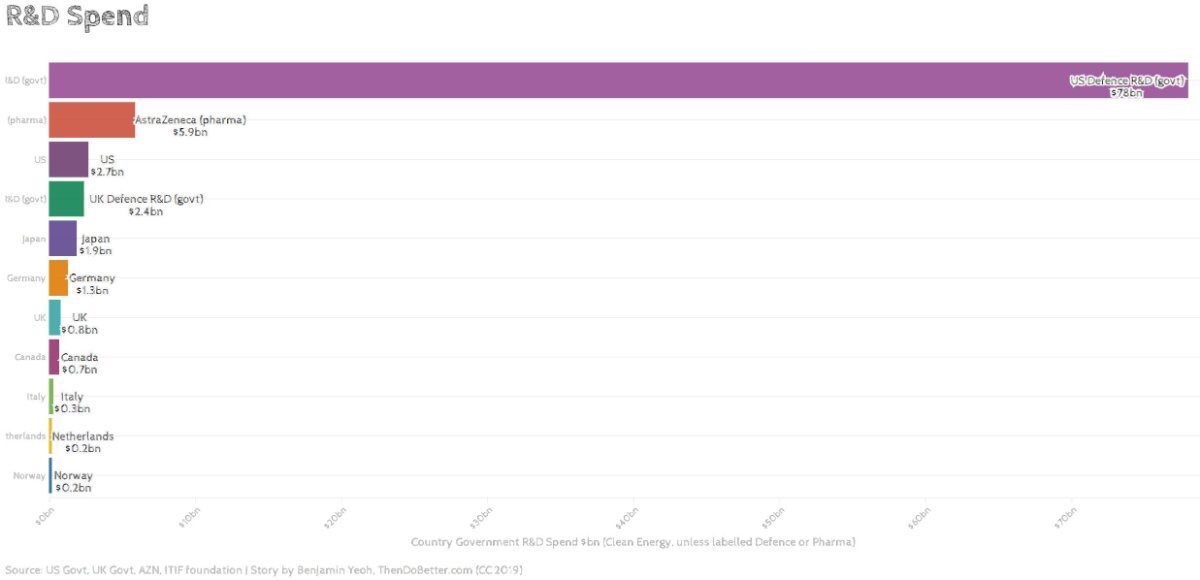
Further research for Thinking Bigly. Governments / Society are underspending on clean tech energy R&D. Innovation has to be a major part of the climate solution (across energy, food, materials, buildings, transport, land use) and while we can be deploying more technologies now, we also need to be investing more.


Especially versus levels of spending in other domains.


Government Spending on Clean Tech R&D vs Defence (UK/US):

Norway                           0.2

Netherlands                     0.2

Italy                                  0.3

Canada                             0.7

UK                                    0.8

Germany                          1.3

Japan                                1.9

UK Def R&D (govt)          2.4

US                                     2.7

AstraZeneca (pharma)    5.9

US Defence R&D (govt)  78


US spends $78bn on military R&D and $2.7bn on clean tech.

UK spends $2.4bn on Def R&D and $0.8bn on clean tech.

AZ for random comparator, as private pharma company spends $5.9bn in R&D.


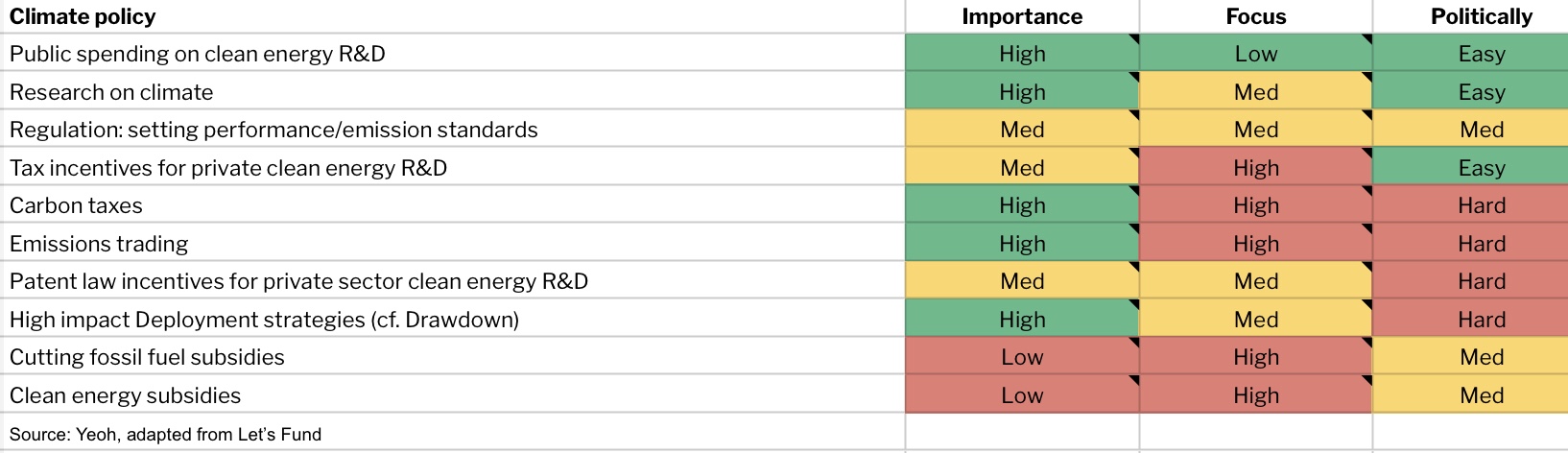
This leads me to my own take of where the importance and focus and political ease of the current policy line up is(see below). Many aspects are hard re: politics but this strikes me as potentially easy. Market-minded people still tend to believe that basic research is suited to government and universities and this can scale up to commercial development.

public.jpeg

There may be an argument for moral equity as well because while typically private companies want to reduce “spillover” from its R&D discoveries so that more wealth is generated to them; from the point of view of the planet a spillover generated from eg the UK that goes to eg India would be welcome and the positive spillover could be equitable as the eg UK had burned most the carbon budget in earlier decades creating the negative polluting externality.


More resources on Thinking Bigly here

Specific thoughts on carbon tax here.

And risk thinker Nassim Taleb on climate change and risk here.

In ESG, Investing, Regulation Tags Research, Carbon, Environment, Energy

Sustainability: Resources and ideas behind Thinking Bigly

June 15, 2019 Ben Yeoh
bigly-pict-crop.jpg

Thinking Bigly - a guide to saving the world.

I take a look at the complexities around sustainability challenges and offer a combination of solutions, on both a personal and systemic levels. (If you are here from Thinking Bigly - thanks!) This is draft incomplete summary of the research sources, notes and ideas behind the project. If there is something you would like to add (eg letter templates) or comments message me as I will add them slowly as time allows.

Major sustainability ideas in Thinking Bigly are:

↠Reduce/Reuse/Recycle/Waste less

↠Support culture and behaviour change

↠Support Innovation

↠Advocate for carbon pricing

↠Advocate for performance/efficiency standards

↠Think second order.

↠Discuss ideas with people who don’t think like you

↠Petition

And they spring along side ideas of (1) Cultural/Behaviour Change and (2) Second Order thinking. They are supported by evidence that cultural change can happen fast enough (eg abolition of slavery, pink becoming a girl’s colour) and that the problem is manageable as it is concentrated in (i) 7 countries (50% emmission) and (ii) cities (50% of people) and (iii) 5 broad areas which policy can impact (buildings, industry, transport, agriculture and energy).

↠Reduce/Reuse/Recycle/Waste less

-Major emphasis on consuming/buying less or differently


Look for win-win or close substitutes

-eating/cooking with friends vs take out

-video call vs long distance travel to meeting

-second-hand clothes or technology, extend use

-junk modelling for toys

-hand-made gifts, poems, mix-tapes

-own-grown food


This list could be very long and is driven by a mix of personal and/or cultural change.

It’s typically what a frugally minded person would do overall. While individually the impacts are small, it adds signals.


Consider bending vs social norms

-wash clothes less (eg unless really smell)

-wash less

-travel slower (walk, bike)

-always take food leftovers from restaurants

-ignore best before dates and use cooking skills


Again this list is very long but bends closer to re-shaping or re-imagining the cultural stories and myths we’ve told ourselves (this is where the stories of the colour pink or making slavery illegal or how we wear our clothes and all other type of “intersubjective myth” come from - it’s true as many humans believe it to be true).


-Significant purchases go for quality/sustainability (even if costs more short-term)

-green energy; fridge; washing machines, cookers

-boilers, heating, insulation

-technology, furniture, mattresses


Major decisions will impact over long cycles eg the washing machine or fridge - sustainable energy and use pay back is significant for these items.


Those signals are targeted at an individual level that collectively signals but equally, if not more important is what we can advocate on the systems or wider level.


↠Support Innovation

Use your choices and conversation to support innovation

-consider innovation investments

-supporting friends ideas and job choices

-encourage innovation thinking and debate

-be wide and second-order in your choices

-encourage companies, leaders to innovate


As described below, innovation has to be a major part of the answer (even if we can’t or don’t want to change behaviours). This can be supporting innovation ideas (eg Drawdown) or policy.


↠Support pricing signals such as carbon pricing

While I hear arguments for non-market based ideas, my pragmatic view is that a market pricing signal such as a carbon price needs to be an important part of the answer. A pricing signal is not sufficient in itself it needs to be supported by innovations and performance standards and other supportive policies (eg urban design, labelling) but I don’t see any politically viable alternative at this point in time and even this policy has struggled due to its unequal impact (for those who support social justice) and its taxing nature (for those who dislike taxes).


↠Support performance standards


Performance standards or similar  will need to be wide ranging over several sectors eg industry efficiency, building codes and transport. But they are necessary alongside innovation and pricing signals, they help solve a split incentive alignment problem.


Eg Building owners vs building renters.  Owners/builders have to make the capital investment, but renters take the gains/losses of energy efficient buildings. A well-enforced building code is needed.


There are simple principles of good policy design that need to be thought through to avoid loop holes and second order unintended consequences.  These are:

i) Long-term certainty so business can plan

ii) Continuous improvement built-in because the world constantly updates

iii) Focus on outcomes not individual tech as policy can’t predict individual winners

iv) Simplicity to prevent gaming


Finally I support the collision and mixing of ideas so that we collectively grow the pie, as well as split it more fairly, and focus on the most impactful matters:


↠Be second order thinker and use influence

There are many unintended consequences of first order thinking, both negative and positive.

Go beyond first order thinking to second order

-Education over divestment

-Cultural behaviour change over sell-by dates

Consider letter writing or petitions to spread ideas

-to CEOs

-politicians

Discuss ideas with friends, research and innovate

-talk to those who don’t think like you

-find second order win-win ideas

-tell people


Part 1

Background and resources:

There are different components of Sustainability: Climate, Green House Gases, Water, Biodiversity, Waste, Air pollution, Land Pollution, Energy, Food, Innovation. They are summed up imperfectly here within the UN Sustainable Development Goals (SDGs).

Global-Goals.png

There are many components of the sustainability challenges although climate change and for instance plastic waste are two of the most high profile.

Many of the challenges intersect with one another and intersect with positive human development such as within education and equality. Some of these ideas are relatively newly accepted for humanity (eg equality) in the last 100 to 200 years.

Four broad frameworks which each provide a useful lens on the challenges are:

-The Sustainable Development Goals (UN SDGs)

-The Human Development Index

-The Peace Index

-The Happiness Index


A discussion on these broad indices of human development are beyond this article. But, do go to the relevant indices. (Other sources: Consider reading Amaryta Sen’s Development as Freedom and for a lay overview of human history, Harari’s Sapiens.)


Climate Change: Framing the challenge

I’m going to focus this next part on the challenges of climate change bearing in mind that other challenges intersect with climate change.

public.jpeg

Out of this, it’s worth noting that the challenges go across mostly 5 sectors and and a large part of what humanity is involved in.

It’s not only energy production and direct use. Electricity use is about 25% of the challenge. That leaves 75% in other areas.


….Supposedly: 100 companies are responsible for 71% of global emissions: why don't we take the fight there instead?

This statistic is correct, but misleading without context. It derives from the fact that 100 fossil fuel producers originate  71% of carbon emissions. It includes the use of the fossil fuels produced.

That means the person using a fossil fuel car or train and the manufacturer powering their factories (to make stuff for you to buy, or fertilizer for your food to eat) the emissions they produce are accounted as part of this 71%. While the fuel is produced by the oil and gas companies, the residual person responsible for the emissions is typically the end consumer.

Halting  these 100 companies would be banning the production of fossil fuel. (This is equivalent to a type of infinite carbon tax). This may work in the very long term, it is not a good transition plan if we want humanity to survive today (or the next 50 years)....


Many of the remaining areas will need to be solved by new innovation as well as a change in current practice.


While on an individual level our impact is small, in aggregate the “Demand” or the consumer side of the challenge is 60% to 70% of the pie. Supply side is  30% of the problem.


This is tricky for multiple reasons. A critical difficulty for human economic development is that “economic growth” has been a major factor in supporting people out of poverty but that many challenges ask humans to consume less (much less in wealthy nations) as well as innovate more.


Several solutions to asking people to consume less (eg carbon taxes, use less coal) fall unequally across rich / poor people and rich / poor nations.


Other solutions rely on innovation we haven’t invented yet.


Most of the solutions on reducing the demand side require behavioural change that humans have found difficult to do.


Certain solutions require second order (or higher) changes that go counter to other desired aims (for instance, food best before dates save a certain amount of lives from food poisoning (maybe a few hundred in the UK) but have increased food waste (in the hundreds of millions of tonnes, eg 720 million eggs wasted a year in the UK).

https://www.theguardian.com/food/2019/apr/09/britons-throw-away-720m-eggs-a-year-over-best-before-date-fears

https://www.theguardian.com/food/2019/apr/09/britons-throw-away-720m-eggs-a-year-over-best-before-date-fears


….because we find behavioural change hard (but not impossible), I continue to view carbon tax with re-distributive elements (for political justice eg back to poorer people and perhaps into innovation) as useful on systemic basis. A carbon tax enables both business behaviour change as well as personal….


Part Two:

Household Sustainability Decisions

At the level of the household, we can look at these items:


-Babies & Nappies

Disposable nappies have a larger effect on waste pollution, re-usable nappies have a bigger impact on water use. Energy use is in the same bucket depending on temp. Of washing and how drying is achieved. But the largest impact is having a moderate family size.


-Food & Cooking

Efficient cooking in less developed countries can be an important impact, as well as minimising waste in the food supply chain. In rich countries, it is to be less wasteful on food and moderate ruminant animal use, and to consume a normal amount of calories. This would have a double impact on health.


-Clothing

In rich countries, we need to consume much less in clothing. And probably wash clothes well. But the value in clothing is in its social signalling not in its utility.


-Water

Use less. Behaviour change can be hard.


-Warmth and cooling

-Toilets

-Laundry

Air dry. Use efficient washing machines. Wash less. Consider the implications that its remains still typically a woman’s chore.


-Furniture

-Plastic bags

Single use plastic is often used at least twice (as a bin liner), so from an energy point of view paper bags need to be used 5 to 10x to break even. Cotton bags in the range of 50 to 100x. Shop less, consider what you place in the bag. Tha landfill/waste aspects of plastic bag are worse than paper which degrades/recycles.


-Cars

-Trains

-Flying

-Refrigeration

-Technology

-Mobile phones

-Gardening

-Christmas

-Work and retirement

-Death


Every single item is intersectional with


(i) cultural / behaviour change or norm

(ii) the need for less ie reduce/reuse/recycle

And in many cases (iii) a need for innovation to replace the current carbon intensive use


And in many cases would be supported by iv) innovation in urban design (eg mobility, waste use) and v) performance standards (building codes, vehicle standards) and  vi) carbon pricing.


[This is in draft as I will slowly elaborate on some of these choices]

A round up of household choices for sustainability (Australia govt sponsored) is found here:

http://www.yourhome.gov.au/housing/carbon-zero-carbon-positive


A book looking at this is here:  Household Sustainability: Challenges and Dilemmas in Everyday Life

https://amzn.to/2XdkHOG

(and in sum, https://www.emeraldinsight.com/doi/full/10.1108/IJSHE.24915aaa.011)


Part 3


Letter Writing - power of letters


I think there is surprising strength in a well written hand crafted letter sent to people in positions of power.


These can be linked to consumer choices eg to CEOs of companies and products you buy and admire; or to politicians and policy makers; or to investment managers of your savings.


Typically CEOs do not receive many personal letters. A large number of well crafted letters can cause them to stop and think about why eg. a commitment to a more carbon neutral business model in the future would make sense.


[At some point draft letters and points could be shared here]


Advocating at the level of politicians and policy makers is also helpful. Awareness is there (school strike, XR, divestment) but policy is not yet there.


I’m not thinking a rote template, but a well-thought out letter. (If you write one, I will write one…)


Part 4


Policy


The three major policies would centre around:


-Carbon pricing / tax (pricing signals)

-Support for innovation

-Performance standards


And these would run alongside a raft of other complementary areas such as food supply/waste, transport infrastructure, power infrastructure, urban design, building materials and industry etc.

Carbon tax ideas are here: https://www.thendobetter.com/investing/carbon-tax


A list of innovation and technology ideas can be seen from Project Drawdown:

https://www.drawdown.org/

drawdown.png

A collection of policy ideas can be found here:

https://energyinnovation.org/resources/presentations/


Part 5

Here’s a list of links to raft of ideas, arguments and counter-arguments about what we should be thinking about and doing. These formed source material behind Thinking Bigly.


BP to explain how business chimes with Paris climate deal

Pressure from investors forces UK oil and gas firm to be more transparent on climate change

https://www.theguardian.com/business/2019/feb/01/bp-to-explain-how-business-chimes-with-paris-climate-agreement


David Wallace-Wells on climate: ‘People should be scared – I'm scared’

The journalist and author has claimed climate change will soon render the world uninhabitable, leading his supporters to say he’s telling the terrifying truth and critics to brand him a reckless alarmist. Why is he so worried?


https://www.theguardian.com/environment/2019/feb/03/david-wallace-wells-on-climate-people-should-be-scared-im-scared


Investing Prophet Jeremy Grantham Takes Aim at Climate Change

The veteran money manager will devote $1 billion to helping the world escape catastrophe.


https://www.bloomberg.com/news/articles/2019-01-17/jeremy-grantham-s-1-billion-plan-to-fight-climate-change


How to stop the climate crisis: six lessons from the campaign that saved the ozone

Thirty years ago, all 197 countries got together to ban the gases damaging the Earth’s ozone layer. Now we need to unite to combat an even greater threat. What can we learn from 1989?

https://www.theguardian.com/environment/2019/jan/20/how-to-stop-the-climate-crisis-six-lessons-from-the-campaign-that-saved-the-ozone


the carbon bubble. https://thenearlynow.com/trump-putin-and-the-pipelines-to-nowhere-742d745ce8fd


https://www.wsj.com/articles/pg-e-wildfires-and-the-first-climate-change-bankruptcy-11547820006


The case for “conditional optimism” on climate change - Vox

https://www.vox.com/energy-and-environment/2018/12/28/18156094/conditional-optimism-climate-change

The case for "conditional optimism" on climate change

Limiting the damage requires rapid, radical change — but such changes have happened before.


2020 Vision: why you should see the fossil fuel peak coming - Carbon Tracker Initiative

https://www.carbontracker.org/reports/2020-vision-why-you-should-see-the-fossil-fuel-peak-coming/

2020 Vision: why you should see the fossil fuel peak coming - Carbon Tracker Initiative

The peak in fossil fuel demand will have a dramatic impact on financial markets in the…


How to Shift Public Attitudes and Win the Global Climate Battle - Yale E360

https://e360.yale.edu/features/the-essential-front-in-the-climate-battle-altering-public-attitudes

The world is making progress in decarbonizing economies, but not nearly fast enough, says the former U.S. chief climate negotiator. Here he spells out what forces must come together to marshal the public and political will needed to tackle climate change.


https://www.ecowatch.com/how-to-reduce-food-waste-2628392195.amp.html


https://www.vox.com/energy-and-environment/2018/11/16/18096352/climate-change-clean-energy-policies-guide

Climate change policy can be overwhelming. Here’s a guide to the policies that work.

A new book from veteran energy analyst Hal Harvey simplifies decarbonization.


https://www.nytimes.com/2019/02/12/magazine/climeworks-business-climate-change.html

The Tiny Swiss Company That Thinks It Can Help Stop Climate Change

Two European entrepreneurs want to remove carbon from the air at prices cheap enough to matter.


https://www.stockholmresilience.org/publications/artiklar/2019-02-04-options-for-keeping-the-food-system-within-environmental-limits.html

Options for keeping the food system within environmental limits - Stockholm Resilience Centre

An international centre that advances transdisciplinary research for governance of social-ecological systems.


https://www.thendobetter.com/investing/2019/2/19/significant-major-cross-discipline-eat-lancet-commission-paper-on-sustainable-food


Significant Major cross-discipline EAT-Lancet Commission paper on Sustainable Food

Major cross-discipline EAT-Lancet Commission on Sustainable Food has published its findings (Jan 2019).


https://www.newstatesman.com/politics/economy/2019/02/case-funding-green-new-deal-through-government-debt

The case for funding a Green New Deal through government debt

Humanity will not come to an end if we double debt to GDP ratios, but it could come to an end if we fail to combat climate change.


https://www.ft.com/content/2a0d4caa-337c-11e9-bb0c-42459962a812

The US debate on climate change is heating up

Two different plans to attack the problem could be combined in a workable compromise


https://www.nature.com/articles/s41558-017-0058-9

Nature Climate Change, The price of fast fashion

The fashion industry has changed rapidly in recent years with the increased prevalence of fast fashion, impacting the environment. Efforts to green this polluting industry require action from businesses and consumers.


https://www.thendobetter.com/investing/2019/2/24/new-zealand-looking-at-non-financial-capitals

New Zealand looking at non-financial capitals, more than GDP

The NZ PM talking about the problems with GDP and suggesting NZ should look at a broader set of indicators and changing the way it should make decisions, including a well-being budget in 2019


https://www.wri.org/blog/2017/07/apparel-industrys-environmental-impact-6-graphics

The Apparel Industry’s Environmental Impact in 6 Graphics | World Resources Institute

Growth of the multi-trillion-dollar apparel industry has been fed by "fast fashion," which makes clothing cheaply and quickly with a low price-tag. Six graphics show how this trend and others can add to water stress, pollution and other environmental impacts.


https://www.project-syndicate.org/commentary/climate-change-undeliverable-emissions-targets-by-bjorn-lomborg-2019-02

Faking It on Climate Change | by Bjørn Lomborg

Because honest and deep emissions cuts are staggeringly hard to make, achieving carbon neutrality anytime soon is an empty ambition for almost everywhere. But countries continue to make big promises and massage their emissions numbers to give a false sense of progress on combating global warming.


Steady investments in a changing climate - GOV.UK

https://www.gov.uk/government/speeches/steady-investments-in-a-changing-climate

Steady investments in a changing climate

Emma Howard Boyd, Chair of the Environment Agency speech at the European Bank for Reconstruction and Development


www.blog.google/products/earth/new-app-map-and-monitor-worlds-freshwater-supply/amp/

A new app to map and monitor the world's freshwater supply

In partnership with United Nations Environment, Joint Research Centre and Google, new tools for monitoring global freshwater resources are freely available.


https://www.sciencedirect.com/science/article/pii/S2212094718300495?via%3Dihub

Natural disasters over France a 35 years assessment

Using an exhaustive administrative database, we assess the impact of extreme weather events over French cities between 1982 and 2017.


https://sustainablebrands.com/read/new-metrics/coclear-develops-world-s-first-data-visualization-of-product-carbon-footprints

The World’s First Data Visualization of Product Carbon Footprints

By generating carbon-intensity data for each product, CoClear was able to identify industry trends, as well as track product performance improvements along value chains.


Resistance in the Anthropocene. – David Mattin – Medium

https://medium.com/@DMattin/resistance-in-the-anthropocene-6dde37f0f975

Resistance in the Anthropocene.

Should we turn to civil disobedience to avert looming ecological disaster?


https://www.theguardian.com/environment/2019/mar/25/dont-know-how-to-save-planet-this-is-what-you-can-do

Don't know how to save the planet? This is what you can do

Should we become vegetarians? Is it OK to fly? The author of There Is No Planet B, A Handbook for the Make or Break Years, answers the big question


https://slate.com/technology/2019/02/climate-change-national-emergency-bad-idea.html

Climate Change Is Not a “National Emergency”

A Democratic president shouldn’t try to do the same end run around democracy that Trump is attempting.


https://www.iea.org/geco/emissions/


https://amp.ft.com/content/7889cb6e-501f-11e9-9c76-bf4a0ce37d49

Life after climate change: lessons from Cape Town

The city’s response to a three-year drought offers pointers to the coming ‘new normal’


https://www.nytimes.com/interactive/2019/03/26/climate/wind-solar-energy-workers.html

They Grew Up Around Fossil Fuels. Now, Their Jobs Are in Renewables.

These are portraits of seven people working in wind and solar, industries their families hardly imagined they’d go into. But as one of them put it: “It’s not ideology. It’s just math.”


https://www.theglobeandmail.com/amp/business/commentary/article-the-energy-hungry-world-isnt-waiting-for-canada/

Opinion: The energy-hungry world isn’t waiting for Canada

The country must take a balanced approach to harnessing its natural resources and investing in clean technologies


6 Pressing Questions About Beef and Climate Change, Answered | World Resources Institute

https://www.wri.org/blog/2019/04/6-pressing-questions-about-beef-and-climate-change-answered

There are a lot of misconceptions swirling about beef—its environmental impacts, how it's produced and whether or how much to eat. We examined the latest research to separate myth from fact.


https://www.ft.com/content/9bcb1bf8-5b20-11e9-9dde-7aedca0a081a

Extinction Rebellion: inside the new climate resistance

A new movement plans mass civil disobedience — and its numbers are growing


https://www.sciencedirect.com/science/article/pii/S0304405X19300807

Disaster on the horizon: The price effect of sea level rise

Homes exposed to sea level rise (SLR) sell for approximately 7% less than observably equivalent unexposed properties equidistant from the beach.


Mercer - investing in a time of climate change


ttps://www.theguardian.com/environment/2019/apr/15/david-buckel-lawyer-climate-change-protest

A lawyer set himself on fire to protest climate change. Did anyone care?

David Buckel hoped his death would catalyze action. But what is individual responsibility when confronted with the crisis of a rapidly changing planet?


https://www.nytimes.com/interactive/2019/04/11/magazine/climate-change-exxon-renewable-energy.html


https://www.bankofengland.co.uk/-/media/boe/files/speech/2019/avoiding-the-storm-climate-change-and-the-financial-system-speech-by-sarah-breeden.pdf?la=en&hash=AC28DFEFED7B14A197E6B0CB48044D06F4E38E84


https://www.theguardian.com/environment/2019/apr/21/the-zero-waste-revolution-how-a-new-wave-of-shops-could-end-excess-packaging

The zero-waste revolution: how a new wave of shops could end excess packaging

Shops that minimise the environmental impact of our consumer habits are springing up across Britain. Could they help us avert catastrophe?


Over 4,200 Amazon Workers Push for Climate Change Action, Including Cutting Some Ties to Big Oil - The New York Times

https://www.nytimes.com/2019/04/10/technology/amazon-climate-change-letter.html

They say Amazon should stop offering custom cloud computing services that help the oil and gas industry explore for and extract more fossil fuels.


To Map a Coral Reef, Peel Back the Seawater - The New York Times

https://www.nytimes.com/2019/06/10/science/coral-reefs-mapping-biodiversity.html

To Map a Coral Reef, Peel Back the Seawater

This scientist couple created an airborne observatory to map tropical forests. Now they’re using it to identify threatened reefs.


In Carbon, Arts, Economics, ESG, Investing, Regulation Tags Sustainability, Thinking Bigly, Theatre, ESG, Carbon, policy, Carbon Tax

Good UK Tax Design

June 14, 2019 Ben Yeoh
tax-1.png
tax-2.png

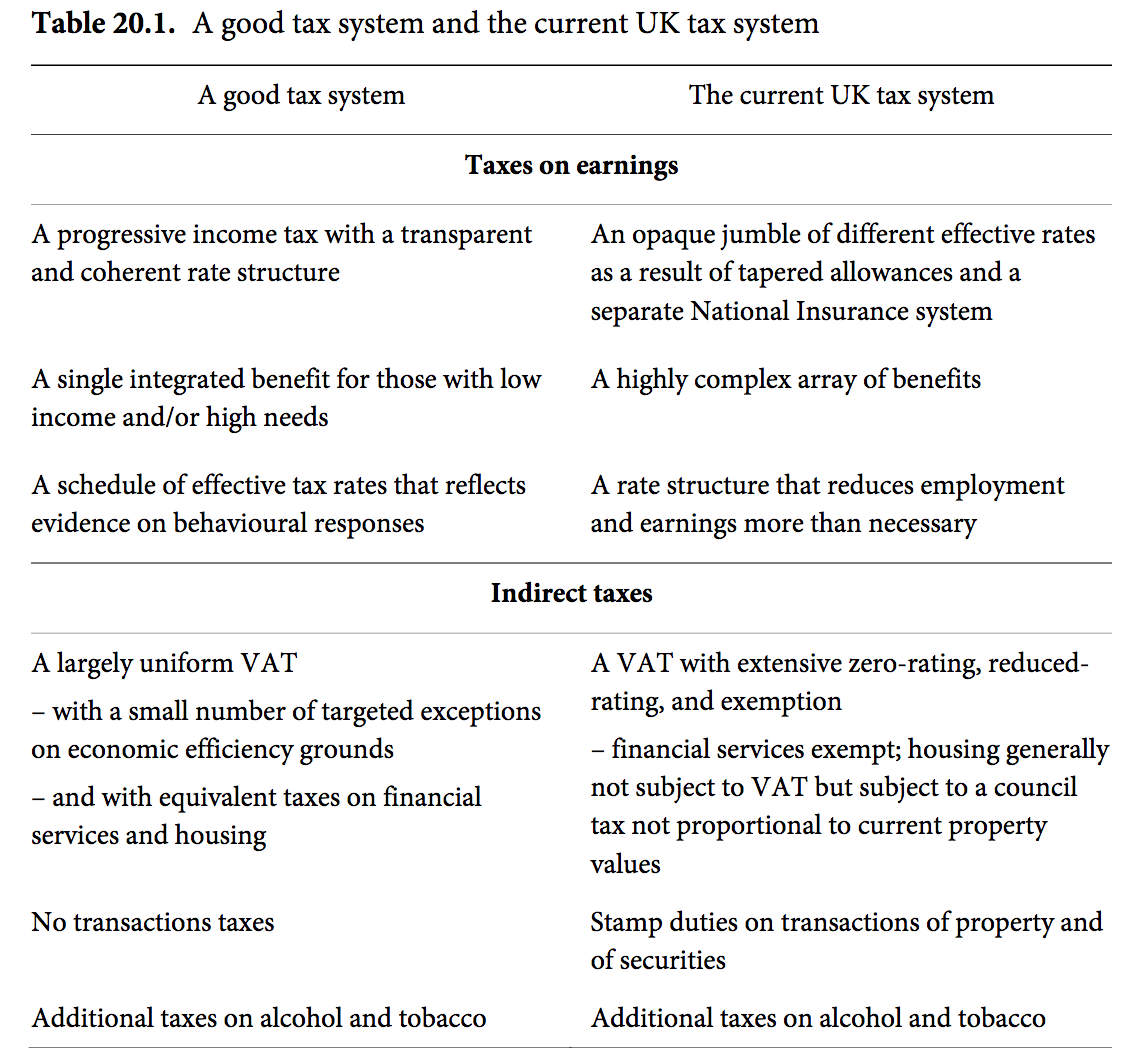
As I continue to check for arugments for/against carbon tax (and they are mostly for), I’ve ended up studying overall what good tax design should look like as if someone designed it now.

Lots of work was done on this all the way back in 2011, summed up in the Mirrlees review. I find it disappointing but unsurprising that most recommendations haven’t been taken up. Still here are the top 7 conclusions and more evidence in support of a wide carbon tax at source. See here for more on carbon tax:

"Against  the criteria  set out in our  vision, the seven  major flaws in the  UK tax system are:

1. Despite  improvements  for some groups  in recent years, the  current system of income taxes and welfare benefits creates serious disincentives to  work for many with relatively low potential earning power. The benefit system in particular is far too complex.


2. Many  unnecessary  complexities and  inconsistencies are  created by the fact  that the various parts  of the tax system are poorly  joined up. These range from a lack  of integration between income taxes and  National Insurance contributions (NICs) to a lack of coherence between personal and corporate taxes.


3.The present treatment of savings and wealth transfers is inconsistent and inequitable.   There is no consistent tax base identified, saving is discouraged, and different forms of savings are taxed differently.


4. We    remain  some way    short of having    a coherent system  of environmental taxes to  address imperatives around climate  change and congestion. The effective tax on carbon varies dramatically according to its source, and fuel duty is a poor substitute for road pricing.


5.The  current  system of  corporate taxes  discourages business  investment and favours debt finance over equity finance. Its lack of integration with other parts of the tax system also leads to distortions over choice of legal form. Corporate taxes have also been subject to increasing international pressures.


6. Taxation  of land and  property is inefficient  and inequitable. There is  a tax on business property—a produced input—but not on land, which is a  source of rents. Taxation of housing involves both a transactions  tax and a tax based on 20-year-old valuations.


7. Distributional goals are pursued in inefficient and inconsistent ways. For example,  zero and reduced rates of VAT help people with particular tastes rather than being targeted at those with low overall resources; and council tax is regressive for no obvious efficiency-improving reasons.”


See here for free downloads - go straight to the conclusions if you don’t want to wade through the evidence!


https://www.thendobetter.com/investing/carbon-tax

https://www.ifs.org.uk/publications/mirrleesreview


In Carbon, Economics, Investing, ESG Tags Tax, Carbon, Carbon tax, Economics

EV charging sites now outnumber petrol stations

June 11, 2019 Ben Yeoh
zapmap-stats.png

Range anxiety? EV charging sites now outnumber petrol stations | Good Energy / Zap Map
“As of yesterday, 28 May, there are 8,546 charging locations across the UK, hosting a total of 13,688 charging devices. In contrast, as of the end of April, there are currently only 8,400 petrol stations in the UK, a figure which is continuing to decline. “

Based on Zap Map, https://www.zap-map.com/statistics/


Me:The transition in the UK is underway. More EV sites than petrol stations (though there are more individual pumps as each stations has 4 to 12 pumps) according to this study. And I’m not sure if they are all in the right places.

This FT article suggests infrastrucutre still poor: https://www.ft.com/content/dfe71424-7c07-11e9-81d2-f785092ab560

https://www.goodenergy.co.uk/blog/2019/05/29/range-anxiety-ev-charging-sites-now-outnumber-petrol-stations/

In ESG, Investing, Carbon, Economics Tags EV, electric, carbon, green

Absolute Mobility, Country Changes, contributions of growth and inequality

May 17, 2019 Ben Yeoh
Berman (2018) https://www.yonatanberman.com/working-papers

Berman (2018) https://www.yonatanberman.com/working-papers

Adding to my growing collection of thoughts on inequality*, I’ve come across this insightful paper.


The work by Yonatan Berman seems very comprehensive. (in above graph)** he shows the rise and fall of absolute mobility as expressed by % children who earn more than parents.


Importantly, he goes on to show that out of the decline in absolute mobility that for most countries he examined, the largest factor was growth and that inequality was only a secondary factor (except in the US, and it’s big part of the UK though even in the UK growth is a bigger factor).

Berman (2018)

Berman (2018)


That’s evidence for the “grow the pie” type of arguments for helping mobility (over “share the pie”)  and that sustainable growth remains the most important factor for improving absolute mobility. Policies can do both but if you had to trade-off in most countries growth seems to be a better option according to this (how that intersects with environmental sustainability and consumerism is a conundrum).


That said, in the US policies that work better on “splitting the pie” (see Dalio on Reforming Capitalism) may have outsized gains given its unique status on inequality being a bigger driver of lower absolute mobility.


It’s a long read but see all of Berman’s papers here on his site: https://www.yonatanberman.com/working-papers


Dalio on Reforming Capitalism:

https://www.thendobetter.com/investing/2019/4/6/ray-dalio-on-reforming-capitalism


And Taleb’s counter to Dalio:

https://www.thendobetter.com/investing/2019/5/17/taleb-on-dalio-capitalism-not-broken-its-skin-in-the-game


A thought on the hypothesis that all war, famine, disasters and the like have been the only major drivers of reducing inequality (policy has been ineffective), (Walter Scheidel’s book, Great Leveller)

https://www.thendobetter.com/investing/2018/3/25/inequality-inevitable-how-bad


A thought on longitudinal inequality:

https://www.thendobetter.com/investing/2019/5/11/a-longitudinal-look-at-inequality


A thought on how innovation potential is lost by inequality: https://www.thendobetter.com/investing/2017/12/4/lost-einsteins-cost-of-inequality


In ESG, Economics Tags Inequality, Economics, Yonatan Berman

A longitudinal look at inequality

May 11, 2019 Ben Yeoh
Source: https://medium.com/@russroberts/do-the-rich-capture-all-the-gains-from-economic-growth-c96d93101f9c   who is referencing https://www.yonatanberman.com/   I think

Source: https://medium.com/@russroberts/do-the-rich-capture-all-the-gains-from-economic-growth-c96d93101f9c who is referencing https://www.yonatanberman.com/ I think

On thinking about the the data around inequality, I had not considered fully the longitudinal data.


This is an oversight especially considering my background. My family started off mid-tier economically, with some low tier/working class (we don’t call it working class in Asia, typically - that’s more a British notion) elements but with a valuable “education asset”.  Objectively, I am now in one of the very highest tiers socio-economically. My family have risen in wealth enormously over the years.


Now my birth tier itself has not improved as much as my current rich tier, but there has been social mobility.  The people in the tier are different.


The social mobility data itself is complex. There is evidence that cities and in the UK especially London do well in promoting social mobility and (to me) this is likely due to agglomeration / network effects. Social mobility happens in rich and poor areas of London, so absolute wealth is not potentially the key problem.


Challenge yourself by reading this blog: https://medium.com/@russroberts/do-the-rich-capture-all-the-gains-from-economic-growth-c96d93101f9c


Dive deeper to a longitudinal study:

Growth, Inequality and Absolute Mobility in the United States, 1962-2014

https://papers.ssrn.com/sol3/papers.cfm?abstract_id=3256993

“…We find that absolute mobility decreases with income. Individuals and families occupying the lower ranks of the income distribution have a higher probability of increasing their income over short time periods than those occupying higher ranks. This also occurs during periods of increasing inequality. Our findings stem from the importance of the changes in the composition of income percentiles. “


Although also see the Dalio piece… mobility is down but 50% of 30 year olds still do earn more than their parents. (this seems to conflict with some Lopoo (Pew Charitable Trust) data - so unsure who is right.

dalio-inequality.png
In Investing, Economics, ESG Tags Inequality, investing
← Newer Posts Older Posts →
Follow me on LinkedIN
Contact/Support