• Home
  • Start Here
  • Podcast
  • Thinking Bigly
  • Investing
  • Arts
    • Contact/Donate
    • Sign Up
    • Search
    • Privacy
    • Disclaimer
    • Arts
    • Investing
    • Newsletter
    • Theatre
    • Poetics
    • India (1997)
    • Indonesia (1998)
    • Popular
    • Blogs
    • Food
    • Photography
    • Personal
    • Mingle
    • Writer Bio
    • Investor Bio
    • Me
    • Yellow Gentlemen
    • Investment Aphorisms
    • Places in Between
    • Grants
    • Angel Investing
    • Shop
    • Unconference
Menu

Then Do Better

Street Address
City, State, Zip
Phone Number

Your Custom Text Here

Then Do Better

  • Home
  • Start Here
  • Podcast
  • Thinking Bigly
  • Investing
  • Arts
  • Support
    • Contact/Donate
    • Sign Up
    • Search
    • Privacy
    • Disclaimer
  • Archive
    • Arts
    • Investing
    • Newsletter
    • Theatre
    • Poetics
    • India (1997)
    • Indonesia (1998)
  • Blogs
    • Popular
    • Blogs
    • Food
    • Photography
    • Personal
  • About
    • Mingle
    • Writer Bio
    • Investor Bio
    • Me
    • Yellow Gentlemen
    • Investment Aphorisms
    • Places in Between
    • Grants
    • Angel Investing
    • Shop
    • Unconference

Kevin Warsh. Future Fed Chair?

October 3, 2017 Ben Yeoh
from predictit.org

from predictit.org

Kevin Warsh could be next Fed Chair. He’s currently favourite in betting markets. A recent meeting with Trump has been confirmed. So, who is he?

Albert Edwards is not known for his optimism (I've worked with him, I should know!) The macro strategist, currently at SocGen, has mostly been an Equity bear for the last decade or so, and has the Ice Age thesis (West would slowly replicate Japan’s experience of the 1990s by descending into outright deflation) on deflation.

But Edwards has written very positively about Warsh. Not something I’ve come to expect from Albert regarding policy makers. This from Edwards after hearing Warsh speak in a Oct 2016 meeting:

“[Warsh] explained  that the Fed has been “captured” by a  groupthink  of  academics led  by  the ‘Secular  Stagnation’ ideas  of  his  friend, Larry  Summers. Rather  than admitting they are  wrong,  this  group, who failed to predict the current economic malaise,have constructed this theory to explain why ever more  stimulus  is  required. In particular Warsh warned that the Fed  had  become  the slave  of the S&P.”  

For Fed watchers it’s worth looking at these articles. Warsh in WSJ in August 2016. He writes:

“The conduct of monetary policy in recent years has been deeply flawed. U.S. economic growth lags prior recoveries, falling short of forecasts and deteriorating in the most recent quarters.”

“Two major obstacles must be overcome: groupthink within the academic economics guild, and the reluctance of central bankers to cede their new power...

First, the economics guild pushed ill-considered new dogmas into the mainstream of monetary policy….

The second obstacle to real reform is no less challenging. Real reform should reverse the trend that makes the Fed a general purpose agency of government…

Warsh as Chair would be shaping a different kinds of Fed it would seem.

And interview with Warsh on CNBC below:

Read a thought on valuations here.  Cross fertilise. Read about the autistic mind here and ideas on the arts here. Ray Dalio on populism and also a thought on risk and valuations. Or Black Swan author, risk expert, on life lessons from his commencement address.

Fed policy running against capital investment: Kevin Warsh from CNBC.

In Investing Tags Fed, Investing

Nassim Taleb. Climate Change Risk.

September 18, 2017 Ben Yeoh
IMG_3709.JPG

On climate change… we should ask “what would the correct policy be if we had no reliable models”? writes Nassim Taleb and co-authors (see below).

We have only one planet.  This fact radically constrains the kinds of risks that are appropriate to take at a large scale. Even a risk with very low probability becomes unacceptable when it affects all of us - there is no reversing mistakes of that magnitude.

Without any precise models, we can still reason that polluting or altering our environment significantly could put us in uncharted territory, with no statistical track-record and potentially large consequences...

While some amount of pollution is inevitable, high quantities of any pollutant put us at a rapidly increasing risk of destabilising the climate, a system integral to the biosphere. Ergo, we should build down CO2 emissions, even regardless of what climate-models tell us.

Push a complex system too far and it will not come back. The popular belief that uncertainty undermines the case for taking seriously the “climate crisis” that scientists tell us we face is the opposite of the truth.

Properly understood, as driving the case for precaution, uncertainty radically underscores that case and may even constitute it. [My emphasis]

I think this case could be pushed more strongly given 3/10 Americans disbelieve manmade climate change. Even with this disbelief, most believe the climate is likely changing and an understanding of the risk framed in Taleb’s view should underscore the need for climate policy.

Source: Taleb's twitter feed

Source: Taleb's twitter feed

Nassim Taleb is not known for liberal left leaning views (although his politics are more complex to easily fit in the left-right axis; his local-global or libertarian axises are - in my view - more important) still this puts Nassim Taleb as a core anti-mainstream-left-thinker and Gregory Mankiw as an economist associated with the Republicans, strongly suggesting (1) Climate change should be taken seriously (in Taleb’s case) and (2) Carbon taxes or some form of Pigovian tax on carbon (in Mankiw’s case) should be enacted.


More from Nassim Taleb thinking on the ethics of stuffing.   or Nassim Taleb's commencement address.  

A post thinking about the pros/cons of a carbon tax (and dividend).

A long thought about various sustainability ideas.


In Investing, Carbon, ESG Tags Taleb, Sustainability, climate, Carbon

Bitcoin. Energy unsustainable.

September 17, 2017 Ben Yeoh
Source: https://digiconomist.net/bitcoin-energy-consumption

Source: https://digiconomist.net/bitcoin-energy-consumption

Bitcoin is unsustainable in light of its energy consumption. Several authors have examined Bitcoin’s energy consumption and concluded Bitcoin is using up as much energy as a medium sized country. Currently about 72 in the world if considered a country.

I can not find a peer review, but I see several independent sources (see end) making their own assumptions, which seem plausible (I am no expert).

I highlight the digiconomist work.  They calculate bitcoin’s energy consumption to power approx 1.5m US households,  They estimate the VISA network to be equivalent to 50,000 households.

See above

See above

As I have argued earlier, I do not believe Bitcoin is a good investment, but it might be thought of as a currency or a money.  Many are excited by the possibilities of blockchain.

This work suggests more needs to be done to make blockchain energy efficient, if this will be a sustainable mechanism.

The author Deetman writes after his calculations: “I haven't given up on the idea of distributed network transactions, but a radical rethinking of how these may be secured would be beneficial, be it at least for the environment.”  And if the calculations made by analysts below are true, I would concur. H/T to  https://digiconomist.net/bitcoin-energy-consumption as source.


References:  Bitcoin Consumes A Lot     Bitcoin Is Still Unsustainable

Electricity consumption of Bitcoin: a market-based and technical analysis

Proof of Work Flaws: Ethereum Lays Out Proof of Stake Philosophy

An Unsustainable Protocol That Must Evolve

Bitcoin Could Consume as Much Electricity as Denmark by 2020

Bitcoins are a waste of electricity    Bitcoin is Unsustainable

How Much Power Does the Bitcoin Network Use?


If you'd like to feel inspired by commencement addresses and life lessons try: Ursula K Le Guin on literature as an operating manual for life;  Neil Gaiman on making wonderful, fabulous, brilliant mistakes; or Nassim Taleb's commencement address; or JK Rowling on the benefits of failure.  Or Charlie Munger on always inverting.

Cross fertilise. Read about the autistic mind here. On investing try a thought on stock valuations.  Or Ray Dalio on populism and risk.  You can also click on the Carbon tag below.

In Carbon, Investing Tags Carbon

Climate Survey

September 14, 2017 Ben Yeoh
Source: Yale Climate Change Communication

Source: Yale Climate Change Communication

3/10 Americans disbelieve manmade climate change. This percentage has been stable for 20 years (with a slight rise to almost 4/10 in some years).

The fine work of the Yale Climate Communication Center focuses on the positive. It heralds the 6/10 who believe in manmade climate change. This proportion has also been stable for 20 years.

This discomforts me as it shows virtually no change in opinion over 20 years.

Climate_Change_American_Mind_May_2017-1.1.png

1/10 to 1 in 8 Americans do not think climate change is happening. I find this still rather high. But perhaps I am out of touch.  1/4  Americans believe in clairvoyance (source Gallup).

Source: Gallup Poll

Source: Gallup Poll

Perhaps, most alarming only about one in eight Americans understand that almost all climate scientists (more than 90%) have concluded human-caused global warming is happening.

If that survey is correct then experts are having limited impact, and, or, peer reviewed robust information is not flowing down to the average American.

This lack of information or even disinformation (which seems to have plagued brexit) is a feature of today’s media that worries me.

The entrenched nature of people’s views also concerns me as it suggests to me there is a diminished ability to compromise and forge agreements from different viewpoints.

`'Public misunderstanding of the scientific consensus – which has been found in each of the Yale surveys since 2008 – has significant consequences. Other research has identified public understanding of the scientific consensus as an important “gateway belief” that influences other important beliefs (i.e., global warming is happening, human caused, a serious problem, and solvable) and support for action.

Updated in 2019: see here “… About seven in ten Americans (69%) think global warming is happening. Only about one in six Americans (16%) think global warming is not happening. Americans who think global warming is happening outnumber those who think it isn’t by more than a 4 to 1 ratio.
• Many Americans are certain that global warming is happening; 46% are “extremely” or “very” sure it is happening. By contrast, far fewer (8%) are “extremely” or “very sure” global warming is not happening.
• A majority of Americans (55%) understand that global warming is mostly human-caused. By contrast, only about one in three (32%) think it is due mostly to natural changes in the environment.
• More than half of Americans (53%) understand that most scientists think global warming is happening. However, only about one in six (17%) understand how strong the level of consensus among scientists is (i.e., that more than 90% of climate scientists think human-caused global warming is happening).
• About six in ten Americans (62%) say they are at least “somewhat worried” about global warming. More than one in five (23%) are “very worried” about it….”

For more information, see: van der Linden, S. L., Leiserowitz, A. A., Feinberg, G. D., & Maibach, E. W. (2015). The scientific consensus on climate change as a gateway belief: Experimental evidence. PLoS ONE, 10(2). doi: 10.1371/journal.pone.0118489

If you'd like to feel inspired by commencement addresses and life lessons try: Ursula K Le Guin on literature as an operating manual for life;  Neil Gaiman on making wonderful, fabulous, brilliant mistakes; or Nassim Taleb's commencement address; or JK Rowling on the benefits of failure.  Or Charlie Munger on always inverting.

Cross fertilise. Read about the autistic mind here. On investing try a thought on stock valuations.  Or Ray Dalio on populism and risk.


In Carbon, ESG, Investing Tags climate, Carbon

Bitcoin. Not an investment.

September 12, 2017 Ben Yeoh
FullSizeRender.jpg

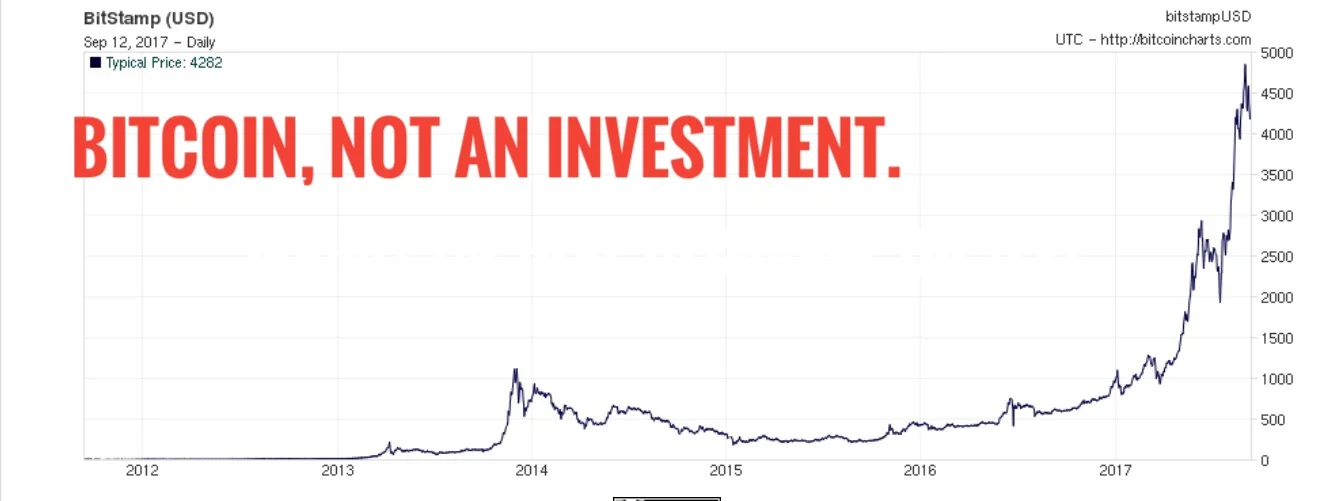
Bitcoin is not an investment (as I define it).  It is a money or a currency. You can speculate in it and trade in it. But I do not think it has a major place for most people as an investment, just like most people would not have South African Rand as an investment.

It does reveal facets of modern money, which we often ignore.  Money relies on belief. Money relies on trust. Its value relies on a network of people who accept it as money. It helps that you can exchange if for goods, services and other currencies. It is not backed by gold, goods or tax.

Go back in time. Sea shells were used as money.

The traditional qualities of money:  durability, handiness or convenience, recognizability and divisibility were mostly embedded in shells.  (Large shells and small shells harder to divide but easier than camels). Cowry shells were still used as currency until the 20th century.

Fiduciary (or trust, fiat) currency was used in China over 2000 years ago, so in that respect bitcoin has a distinguished history to draw upon.

Howard Marks in his latest September memo (here are some thoughts on his July memo) partially adjusts his view on bitcoin, also concluding it is money, but sharing my view (or perhaps I should be sharing his view, Marks being much more distinguished than me!) that is it not a good investment. If you fancy a gamble, sure why not? But know it for what it is. A speculation. Perhaps like gold, it could have a place as geopolitical hedge, as money/gold has done over history, but I still don’t think that makes it an investment. It could make it a “safe asset” (see Andolffi below) but again I’m unsure that’s an investment.

Bitcoin could possibly be valued. There are some valiant attempts. The assumptions and data needed do seem to put it in the realm of speculation.  But, if interested look at some of these writers below:

David Andolfatto (who works for fed reserve bank of st louis)  is great on bitcoin - blog here . His view seems to be bitcoin is lousy money but a possible store of value.  This slide deck here gives a thorough overview of Bitcoin that I recommend.

Tony Yates (former Bank of England) talks about the barriers to cryptocurrencies taking over at an FT guest post.


If you'd like to feel inspired by life lessons try: Ursula K Le Guin on literature as an operating manual for life;  Neil Gaiman on making wonderful, fabulous, brilliant mistakes; or Nassim Taleb's commencement address; or JK Rowling on the benefits of failure.  Or Charlie Munger on always inverting. 


Eric Lonnergan on an overview of Bitcoin’s characteristics including “intelligence” in aspects of “self-regulation”  (I’m personally unsure if that’s ‘true’ intelligence cf. Shells, gold) . Lonnergan writes: “Bitcoin’s ‘intelligence’ involves the application of a very simple rule: the quantity expands to 21 million and then it ‘grows’ at zero percent. I’m less interested in the merits of this rule, which are well-rehearsed, than the possibilities it suggests. The ‘intelligence’ of money could be extended in many interesting ways. From an economic standpoint, the obvious improvement in intelligence would be to design a currency which expands and contracts in line with demand for currency. Embedding this in the currency’s DNA would render central bank decision-making redundant – to everyone’s advantage. ‘Intelligence’ could also embed social goals – for example the currency could self-regulate the activities for which it is used, perhaps even rewarding or punishing activities contingent on their social impact.”

Howard Marks is always worth reading if you have any interest in markets and the world.

Marks caution joins the chimes of Ray Dalio (post here), John Hussman (post here) along with Albert Edwards (currently at SocGen (with Andrew Lapthorne, his recent chart here), and to some extent James Montier (who also worked alongside Albert at DK previously, but has a behavioural economist streak to his work; now at GMO) and Jeremy Grantham (at GMO) have tended to put quite some weight on these type of metrics and valuation discipline, at least for long cycle returns (around 7 years). It's interesting that most of this group are chiming quite loudly, with the possible exception of Grantham who is ringing in a slightly different key (suggesting much slower reversions to the mean than before).

The world of macro has so many cross currents. 

There is another interesting chime with Nassim Taleb's thinking from his pop risk books. This idea that we do not handle "fat tails" or "Black Swan" events very well.  That models do not account for these events well (real world is not "normal" or "gaussian").  This dovetails well with Hyman Minsky's observation/theory on why we have and will always have boom/bust cycles.  

In Investing Tags investing, bitcoin

CEO-Chair Governance.

September 9, 2017 Ben Yeoh
FullSizeRender.jpg

“For investors...If your company allows too much power to reside in the hands of the chief executive, do not be surprised if they abuse that power.” Writes John Authers in the FT 6 Sep, link here.

“We all know why companies manipulate their earnings. They do it because they can. Accounting principles necessarily allow some discretion beyond the direct moves that show up in cash terms each quarter. And there are rewards for manipulation — stronger earnings will be greeted by higher share prices. That means cheaper equity finance for the company, and more pay for any executives whose remuneration is linked to share performance.”

Authers looks at this paper by Chu et al, A Reputation for Beating Analysts' Expectations and the Slippery Slope to Earnings Manipulation.  (Link here, first posted 2015, last revised June 2017, as of writing)

“We analyze firms subject to SEC enforcement actions and find that these firms are both more likely to consistently beat analysts’ quarterly earnings forecasts during the manipulation period as well as in the three years prior to the manipulation period. We examine whether manipulating firms appear to be under strong external market pressure to meet expectations. Consistent with market pressure playing a role, we find that manipulating firms have high long-term growth expectations, growing institutional investment, high market values relative to fundamentals, and are strongly recommended by analysts. We also investigate whether pressure from within the organization influences the likelihood of manipulation. We find that while CEO power plays a role, the evidence on CEO overconfidence is weak. Overall, our results suggest that maintaining a reputation for meeting analysts’ expectations can encourage aggressive accounting and, ultimately, earnings manipulation.” Chu writes.

Chu quotes: ““(T)he Wall Street number was pure. It was somebody else independent of me saying, “Stephen, this is what you need to aim for this quarter.” I would judge my success on the ability to make that number. If we achieved that number, it was an endorsement that we were doing the right things. If we missed that number, then it was a reflection that we hadn’t performed as well as we should have. My goal was just to get to or over that number – and if I did that, I succeeded.” Stephen Richards Global Head of Sales at Computer Associates.”

“If a CEO sets meeting expectations as an organization goal, then a powerful CEO is more likely to be able to influence employees to achieve this outcome. We measure CEO power in three ways:

1) the CEO has the dual role of CEO and Chairman of the 2) the board of directors has fewer independent board members; and 3) the CEO receives a larger cash “pay slice” measured as the ratio of cash-based CEO compensation relative to the second highest paid executive.

Our evidence suggests that executives at manipulating firms could face strong internal pressure to continue the trend of consistently beating expectations. In univariate analysis, we find that manipulating firms are more likely to have overconfident and powerful CEOs.”

There may be exceptions, such as Warren Buffet, but my conclusion is - despite what many CEOs say particularly in the US - this is evidence that a separate Chair and CEO structure is a superior structure to a combined CEO/Chair.

In ESG Tags ESG

Communicating. Tesla.

September 7, 2017 Ben Yeoh
(CC)  Maurizio Pesce Tesla Factory

(CC)  Maurizio Pesce Tesla Factory

There are two schools of thought about how information should flow within companies. By far the most common way is chain of command, which means that you always flow communication through your manager. The problem with this approach is that, while it serves to enhance the power of the manager, it fails to serve the company, Elon Musk of Tesla wrote.

Instead of a problem getting solved quickly, where a person in one dept talks to a person in another dept and makes the right thing happen, people are forced to talk to their manager who talks to their manager who talks to the manager in the other dept who talks to someone on his team. Then the info has to flow back the other way again. This is incredibly dumb. Any manager who allows this to happen, let alone encourages it, will soon find themselves working at another company. No kidding.

Anyone at Tesla can and should email/talk to anyone else according to what they think is the fastest way to solve a problem for the benefit of the whole company. You can talk to your manager's manager without his permission, you can talk directly to a VP in another dept, you can talk to me, you can talk to anyone without anyone else's permission. Moreover, you should consider yourself obligated to do so until the right thing happens. The point here is not random chitchat, but rather ensuring that we execute ultra-fast and well. We obviously cannot compete with the big car companies in size, so we must do so with intelligence and agility.

One final point is that managers should work hard to ensure that they are not creating silos within the company that create an us vs. them mentality or impede communication in any way. This is unfortunately a natural tendency and needs to be actively fought. How can it possibly help Tesla for depts to erect barriers between themselves or see their success as relative within the company instead of collective? We are all in the same boat. Always view yourself as working for the good of the company and never your dept.

H/T Justin Bariso. As Bariso writes "It's extremely difficult to cultivate in the real world." There is a further problem of communication content and communication delivery. I've certainly made mistakes in communication delivery. It take much longer to craft 200 words to express a complex matter then it does to say it 800 words. The 200 words will be better expressed and more succinct; but well written takes longer.

"If I had more time, I would have written a shorter letter."  which is attributed to many different writers. 

This difficulty in free expression is one of the reasons why psychological safety as researched by Amy Edmondson and Google Research is so important.

Few people like being told they are not doing their job well. Nevertheless, we should judge if constructive criticism is coming from a place of malicious intent, or positive intent. If positive, then it needs to be taken in the spirit it is given and we can all improve. I believe much internal commentary is with constructive intent - when that is believed, a team gains psychological safety.

If you'd like to feel inspired by other addresses and life lessons try: Ursula K Le Guin on literature as an operating manual for life;  Neil Gaiman on making wonderful, fabulous, brilliant mistakes; or Nassim Taleb's commencement address; or JK Rowling on the benefits of failure.  Or Charlie Munger on always inverting.

Cross fertilise. Read about theautistic mind here. On investing try a thought on stock valuations.  Or Ray Dalio on populism and risk.

In Investing, Leadership Tags leadership

Hmmm Charts. GSK.

September 2, 2017 Ben Yeoh
Source Bloomberg  

Source Bloomberg  

This is GSK (GlaxoSmithKline, large pharmaceutical company, UK) stock since 2001, relative to a World Healthcare Index. The stock has lost a lot of value relative to other healthcare companies over the last 20 or so years.

New CEO, Emma Walmsley has her work cut out for her. In a recent FT article:

Her advice for young women wishing to scale the heights of her own industry, or any other? “Take courage . . . be unafraid.”

On R&D: “I think having a fresh pair of eyes is actually incredibly helpful, whether you’re deciding which therapy areas you want to be in or which assets you want to back, or which people you want to hire or which people you think should be part of the company in the future. “I have no baggage and so it’s not been difficult to take a relatively clear-eyed view.”

Stock price is not everything. Nevertheless if it is a correlate in pharmaceutical companies for the amount of productive R&D created then the chart above highlights the scale of the problem.

Cross fertilise. Read about theautistic mind here. On investing try a thought on stock valuations.  Or Ray Dalio on populism and risk.


If you'd like to feel inspired by other addresses and life lessons try: Ursula K Le Guin on literature as an operating manual for life;  Neil Gaiman on making wonderful, fabulous, brilliant mistakes; or Nassim Taleb's commencement address; or JK Rowling on the benefits of failure.  Or Charlie Munger on always inverting.

In Investing Tags Healthcare
← Newer Posts Older Posts →
Follow me on LinkedIN
Contact/Support