• Home
  • Start Here
  • Podcast
  • Investing
  • Writing & Arts
  • About
    • Mirror Man
    • Thinking Bigly
    • Yellow Gentlemen
    • Places in Between
    • Meet-up
    • Investment Aphorisms
    • Angel Investing
    • Mingle (old)
    • Arts
    • Investing
    • Newsletter
    • Theatre
    • Poetics
    • India (1997)
    • Indonesia (1998)
    • Unconference (Chatham House)
    • Grants
    • Privacy
    • Disclaimer
    • Contact
  • Search
Menu

Then Do Better

Street Address
City, State, Zip
Phone Number

Your Custom Text Here

Then Do Better

  • Home
  • Start Here
  • Podcast
  • Investing
  • Writing & Arts
  • About
  • Archive
    • Mirror Man
    • Thinking Bigly
    • Yellow Gentlemen
    • Places in Between
    • Meet-up
    • Investment Aphorisms
    • Angel Investing
    • Mingle (old)
    • Arts
    • Investing
    • Newsletter
    • Theatre
    • Poetics
    • India (1997)
    • Indonesia (1998)
    • Unconference (Chatham House)
    • Grants
    • Privacy
    • Disclaimer
    • Contact
  • Search

Writing Craft Tools

September 3, 2017 Ben Yeoh
FullSizeRender.jpg

The most influential writing books of all time? The winner, no doubt, would be The Elements of Style by the teacher/ student team of William Strunk Jr. and E. B. White, Roy Peter Clark writes.

Next on the list would be On Writing Well by William Zinsser, which has sold more than one million copies over the last thirty years. If I had to summarize Zinsser’s advice in three words, it would be “Dump the clutter.”

Not far below [on popular lists] Writing Down the Bones, by Natalie Goldberg; Bird by Bird, by Anne Lamott; On Writing, by Stephen King; [I would add Steering the Craft, by Ursula Le Guin, post here on the Le Guin book.]

These are noble and practical writing guides that deserve their place on your bookshelf, within arm’s reach of your computer. What I like best about them is that they combine narratives of the writer’s life with elements of the writer’s craft. Over the last ten years there has been one [...] that has elbowed its way into the company of these classics: Writing Tools: 50 Essential Strategies for Every Writer By Roy Peter Clark.

Selection of Tool headings from Clark's book

Selection of Tool headings from Clark's book

I was unaware of Clark's book when starting out as a writer. Recently, I picked it up and it has given me good food for thought.

It is strong for non-fiction narrative and journalism. Business communicators and press release writers would greatly benefit. There are ideas for fiction narrative and script writers, but to my mind not quite as strong for them - still worth buying.

The book is light on dramatic structure compared to Story, by Robert McKee (and other dramatic structure books, to be a post another time) but excellent on clarity, sentence and style.

Dwell on Clark's first tip, after this excerpt from his introduction (below video). Listen to Clark on his Let Words Collide concept, via TedX, Youtube).

"...this book invites you to imagine the act of writing less as a special talent and more as a purposeful craft. Think of writing as carpentry, and consider this book your toolbox. You can borrow a writing tool at any time, and here’s another secret: Unlike hammers, chisels, and rakes, writing tools never have to be returned. They can be cleaned, sharpened, and passed along."

TOOL 1 . Begin sentences with subjects and verbs. Make meaning early, then let weaker elements branch to the right.

Imagine each sentence you write printed on the world’s widest piece of paper. In English, a sentence stretches from left to right. Now imagine this. A writer composes a sentence with subject and verb at the beginning, followed by other subordinate elements, creating what scholars call a right-branching sentence. I just created one. Subject and verb of the main clause join on the left (“ a writer composes”) while all other elements branch to the right. Here’s another right-branching sentence, written by Lydia Polgreen as the lead of a news story in the New York Times:

Rebels seized control of Cap Haitien, Haiti’s second largest city, on Sunday, meeting little resistance as hundreds of residents cheered, burned the police station, plundered food from port warehouses and looted the airport, which was quickly closed. Police officers and armed supporters of President Jean-Bertrand Aristide fled.

That first sentence contains thirty-seven words and ripples with action. The sentence is so full, in fact, that it threatens to fly apart like an overheated engine. But the writer guides the reader by capturing meaning in the first three words: “Rebels seized control.” Think of that main clause as the locomotive that pulls all the cars that follow.

Master writers can craft page after page of sentences written in this structure. Consider this passage by John Steinbeck from Cannery Row, describing the routine of a marine scientist named Doc (the emphasis is mine):

He didn’t need a clock. He had been working in a tidal pattern so long that he could feel a tide change in his sleep. In the dawn he awakened, looked out through the windshield and saw that the water was already retreating down the bouldery flat. He drank some hot coffee, ate three sandwiches, and had a quart of beer.

The tide goes out imperceptibly. The boulders show and seem to rise up and the ocean recedes leaving little pools, leaving wet weed and moss and sponge, iridescence and brown and blue and China red. On the bottoms lie the incredible refuse of the sea, shells broken and chipped and bits of skeleton, claws, the whole sea bottom a fantastic cemetery on which the living scamper and scramble.

Steinbeck places subject and verb at or near the beginning of each sentence. Clarity and narrative energy flow through the passage, as one sentence builds on another. He avoids monotony by including the occasional brief introductory phrase (“In the dawn”) and by varying the lengths of his sentences, a writing tool we will consider later.

Subject and verb are often separated in prose, usually because we want to tell the reader something about the subject before we get to the verb. This delay, even for good reasons, risks confusing the reader. With care, it can work:

The stories about my childhood, the ones that stuck, that got told and retold at dinner tables, to dates as I sat by red-faced, to my own children by my father later on, are stories of running away.

So begins Anna Quindlen’s memoir How Reading Changed My Life, a lead sentence with thirty-one words between subject and verb. When the topic is more technical, the typical effect of separation is confusion, exemplified by this clumsy effort:

A bill that would exclude tax income from the assessed value of new homes from the state education funding formula could mean a loss of revenue for Chesapeake County schools.

Eighteen words separate the subject, “bill,” from its weak verb, “could mean,” a fatal flaw that turns what could be an important civic story into gibberish.

If the writer wants to create suspense, or build tension, or make the reader wait and wonder, or join a journey of discovery, or hold on for dear life, he can save subject and verb of the main clause until later. As I just did.

Kelley Benham, a former student of mine, reached for this tool when called on to write the obituary of Terry Schiavo, the woman whose long illness and controversial death became the center of an international debate about the end of life:

Before the prayer warriors massed outside her window, before gavels pounded in six courts, before the Vatican issued a statement, before the president signed a midnight law and the Supreme Court turned its head, Terri Schiavo was just an ordinary girl, with two overweight cats, an unglamorous job and a typical American life.

By delaying the main subject and verb, the writer tightens the tension between a celebrated cause and an ordinary girl.

This variation works only when most sentences branch to the right, a pattern that creates meaning, momentum, and literary power. “The brilliant room collapses,” writes Carol Shields in The Stone Diaries,

leaving a solid block of darkness. Only her body survives, and the problem of what to do with it. It has not turned to dust. A bright, droll, clarifying knowledge comes over her at the thought of her limbs and organs transformed to biblical dust or even funereal ashes. Laughable.

And admirable.


Amazon Affiliate links to books mentioned below:

Writing Tools: 50 Essential Strategies for Every Writer
By Roy Peter Clark
The Elements of Style
By William Strunk Jr., E. B. White
On Writing: A Memoir of the Craft
By Stephen King
Writing Down the Bones: Freeing the Writer Within
By Natalie Goldberg
On Writing Well
By William Zinsser
Bird by Bird: Instructions on Writing and Life
By Anne Lamott

Cross fertilise. Read about the autistic mind here. On investing try a thought on stock valuations.  Or Ray Dalio on populism and risk.

If you'd like to feel inspired by other addresses and life lessons try: Ursula K Le Guin on literature as an operating manual for life;  Neil Gaiman on making wonderful, fabulous, brilliant mistakes; or Nassim Taleb's commencement address; or JK Rowling on the benefits of failure.  Or Charlie Munger on always inverting.

In Writing Tags craft, Writing

Incomplete and Random

August 31, 2017 Ben Yeoh
FullSizeRender.jpg

The title itself is suggestive. It's on the longer side of titles, but "incomplete" hints at the short and splintered scenes to come.

IMG_2460.JPG

The first scene is two lines, and two single words. It suggests a writer who knows what they are about.  You're going to be in for a supremely confident ride (or maybe a complete disaster). 

The second scene already seems to hint at sub text and potentially conflicting intentions. Again establishing a notion of "drama" / conflict as opposed to any (unnecessary) exposition.

Michael Billington review in the Guardian in 2005.  

"...Ten years ago, the Royal Court was the focus for what became known as "in-yer-face" theatre. Now it seems to be encouraging what I can only call "behind-your-back" drama: elliptical, oblique, non-linear plays that leave the audience to piece together narrative and meaning...."

David Eldridge has a new play coming to the National Theatre in October 2017.  It's called Beginning - "Tender and funny, it’s an intimate look at the first fragile moments of risking your heart and taking a chance." Eldridge is in conversation with director Polly Findlay  6pm 19 Oct.

Part of an intermittant series looking at the beginnings of plays. Click here to see a few more like dirty butterfly and Gertrude Stein's Mexico,

Cross fertilise. Read about the autistic mind here and ideas on the arts here. On investing try a thought on stock valuations.  Or Ray Dalio on populism and risk.

If you'd like to feel inspired by other addresses and life lessons try: Ursula K Le Guin on literature as an operating manual for life;  Neil Gaiman on making wonderful, fabulous, brilliant mistakes; or Nassim Taleb's commencement address; or JK Rowling on the benefits of failure.

In Writing, Theatre Tags beginnings

Life Lessons. Matt Haig.

August 26, 2017 Ben Yeoh
Matt Haig / Emily Dickinson quote. Image (c) B Yeoh. Video source below from Kingston University Alumunae via Facebook. 

Matt Haig / Emily Dickinson quote. Image (c) B Yeoh. Video source below from Kingston University Alumunae via Facebook. 

Haig has written some great fiction books for adults and children. Perhaps most extraordinary is his non-fiction work, Reasons to Stay Alive.

This is the blurb from the book: WHAT DOES IT MEAN TO FEEL TRULY ALIVE?
Aged 24, Matt Haig’s world caved in. He could see no way to go on living. This is the true story of how he came through crisis, triumphed over an illness that almost destroyed him and learned to live again. A moving, funny and joyous exploration of how to live better, love better and feel more alive, Reasons to Stay Alive is more than a memoir. It is a book about making the most of your time on earth.

‘I wrote this book because the oldest clichés remain the truest. Time heals. The bottom of the valley never provides the clearest view. The tunnel does have light at the end of it, even if we haven’t been able to see it . . . Words, just sometimes, really can set you free.’

Kingston University sends a book each year to its new undergraduates (started 3 years ago; superb idea that other universities or colleges could think about). In 2016, it was Haig's book The Humans. Haig recently accepted an honorary degree from Kingston.

"nothing is fundamental, not even nothing"

You can see his acceptance speech below and some his life advice is extracted below. Haig made a list of things he would have liked to have known. From his website, you can sense he has a fondness for lists. You can read some of his other lists here. It's worth a read too. Sample headings are:  THINGS I LOVE, BOOKS THAT ALTERED MY EXISTENCE; FAVOURITE CHILDHOOD MEMORIES; THINGS I WORRY ABOUT; HORROR-SCOPE FOR 2100; ANNOYING THINGS; FAVOURITE OPENING LINES; and WHY I WRITE.

I've done a list:

  1. Most of the things that are worrying you now will not worry you in a few years. They'll be distant ships on the horizon. Try and reduce them to that size now.
  2. Try very hard to do work you enjoy doing. That should be the main aim. If you enjoy something, you'll be better at doing it. Why waste your working life on something you don't enjoy? In other words, don't take that media sales job in East Croydon. (That's a little bit specific....)
  3. Beware of how fast life travels. The first two decades of your life feel like forever, but your second two decades will feel like a few weeks in comparison. Appreciate that, don't rush your way through life.
  4. (The boring one): Look after yourself. Eat food that doesn't give you mouth ulcers, remember that crisps aren't lunch, drink soft drinks between hard drinks, don't get into pointless arguments on the internet (I'm particularly bad at that one...) , go for a run every now and then (your body is still going to be there in the morning and it will thank you).
  5. Remember that even on the busiest day, there's always time to call the people you love and tell them you love them.
  6. Learn to trust yourself. You'll never be able to know anyone else's mind as well as your own. When I started writing books, I was writing what I imagined other people wanted. That was totally the wrong approach – you can't be a mind reader. You have to trust yourself. If you want to write a silly story about aliens, write that story. Trust your gut and your own inner 'sat nav'. Learn to listen to it. If you get yourself right, you'll get other people right too.
  7. Don't let other people's doubts about you become your own doubts about you.
  8. Don't always head for the cool people. Head for the warm people. Kindness, laughter and love are worth a million tonnes of cool. Life is warmth – aim for warmth.
  9. It's more important to be yourself than to be accepted. I think this is the thing I struggled with the most. All through my 20's and into my 30's I was always agonisingly worried about what people thought of me. It truly is not a good idea wasting so much energy on worrying if you fit in, or trying to translate the frowns of strangers. That inspirational quote on Facebook was actually right – ‘it is far better to stand out as yourself than to blend in as someone else'. As Jim Carrey puts it, "Risk being seen in all your glory.
  10. Read more poetry. At least, read Emily Dickinson.
  11. Try and do some good in the world. This isn't entirely selfless – there is no drug in the universe that will make you feel as good at a deep level as being kind to other people.
  12. Visit new places, taste new foods, read new writers, make new friends. Explore the world but also explore your imagination – resist falling into the same, safe patterns.
  13. Be curious. This is how you stay young, the ultimate anti-ageing tip. Life isn't about what you know, but how much you're interested in knowing.
  14. Your education doesn't end today. You're going to learn a lot more after today, that's what makes life fun. Keep all the doors open.
  15. Stay optimistic. Optimism can be just as valid as pessimism, even more so in fact. Pessimism once told me I wouldn't live to see my 25th birthday. I'm now 42. Optimism can contain as much truth as the opposite. Hold on to whatever hope you've got and shield it like a flame.
  16. Don't be scared. Don't make decisions out of fear. Every wrong decision I've made over the last 20 years were the ‘sensible' ones, but being sensible is very often just a nice euphemism for being scared. One thing anxiety taught me is that when we act according to our fears, we strengthen them and then we end up trapped. Do things because you love doing them, not because they're the safest option – the safest option rarely is actually the safest option.
  17. There will be times when you fail. There will be bad days and there will be struggle, especially if you pursue a dream, but you need the bad days to make the good days seem good and sometimes we actually need to be knocked off track.
  18. Don't be afraid to be vulnerable. If you ever need help, don't be scared to ask for it. When you share your worries, you may be surprised at how supportive people can be.
  19. Live in the present tense. Up until this point, you have been living in the future tense – at school, you're always looking forward to the holidays or worrying about the next test or exam. Then it's pretty much the same thing at university. We're conditioned to live in the future, to work out where and who we want to be. Now though, you have a chance to finally live in the present, so don't spend every second of every day worrying about the what, who and where of the future. This is your present – learn a different lesson, learn to be in the present. The poet Emily Dickinson wrote a poem I discovered shortly after my student life, which said ‘forever is composed of nows'. Try and catch a few of them. You can spend your whole life obsessing about ghosts of the past or worrying about the future, but the corny truth is all there will ever be is what is happening here and the decisions we make in this moment.
  20. Most of all, don't forget to have fun. This is what we're here for – to make our own lives and other peoples' more enjoyable. Whatever journey you embark on after today, don't try and make it a straight line, take the scenic route and look around. We're given one sweet, precious life – enjoy it.

If you'd like to feel inspired by other addresses and life lessons try: Ursula K Le Guin on literature as an operating manual for life;  Neil Gaiman on making wonderful, fabulous, brilliant mistakes; or Nassim Taleb's commencement address; or JK Rowling on the benefits of failure.

I leave you with this tongue in cheek video from Matt on being a self absorbed writer.

In Writing, Arts Tags Writing, Life

Writing Craft

August 23, 2017 Ben Yeoh
FullSizeRender.jpg

I am starting to flex my writing muscles again. I'm looking and (re)looking at books on the craft of writing. Many writers believe that writing benefits from exercise and practice like many endeavours in life. I think that is true. Writers need to write. I also believe you need to read. If you read a lot and write a lot, you will find yourself a writer-reader. Your craft and writing will improve. Maybe you will go on to be published.

When I first started writing in my early 20s (or maybe even earlier as a teenager), I rushed through the rules of grammar and sentence. I stopped by structure which fascinated me then as it fascinates me now. I was in a rush to write in the here and now and not to spend too long on the shoulders of the greats and the classics. Now I'm older and I'm finding much to interest me in older work, perhaps as I've not had a chance to engage with as much current writing.

My wonderful early training by Adrienne Kennedy and Forrest Gander pushed my curiousity and left me in a sense of wonderment that I could write about anything and everything I wanted - that a studied understanding of words, language, sound, rhythms and the like would propel me on.

I am out of practice. On plus side, I'm richer in life experience. I've read more. (Although perhaps too many of the business and academic books Ursula Le Guin and Forrest would despair of). I've had time to absorb more thinking on the classical, so I can be more sure of the rules I must break, the rules I can break and the rules I break accidently.

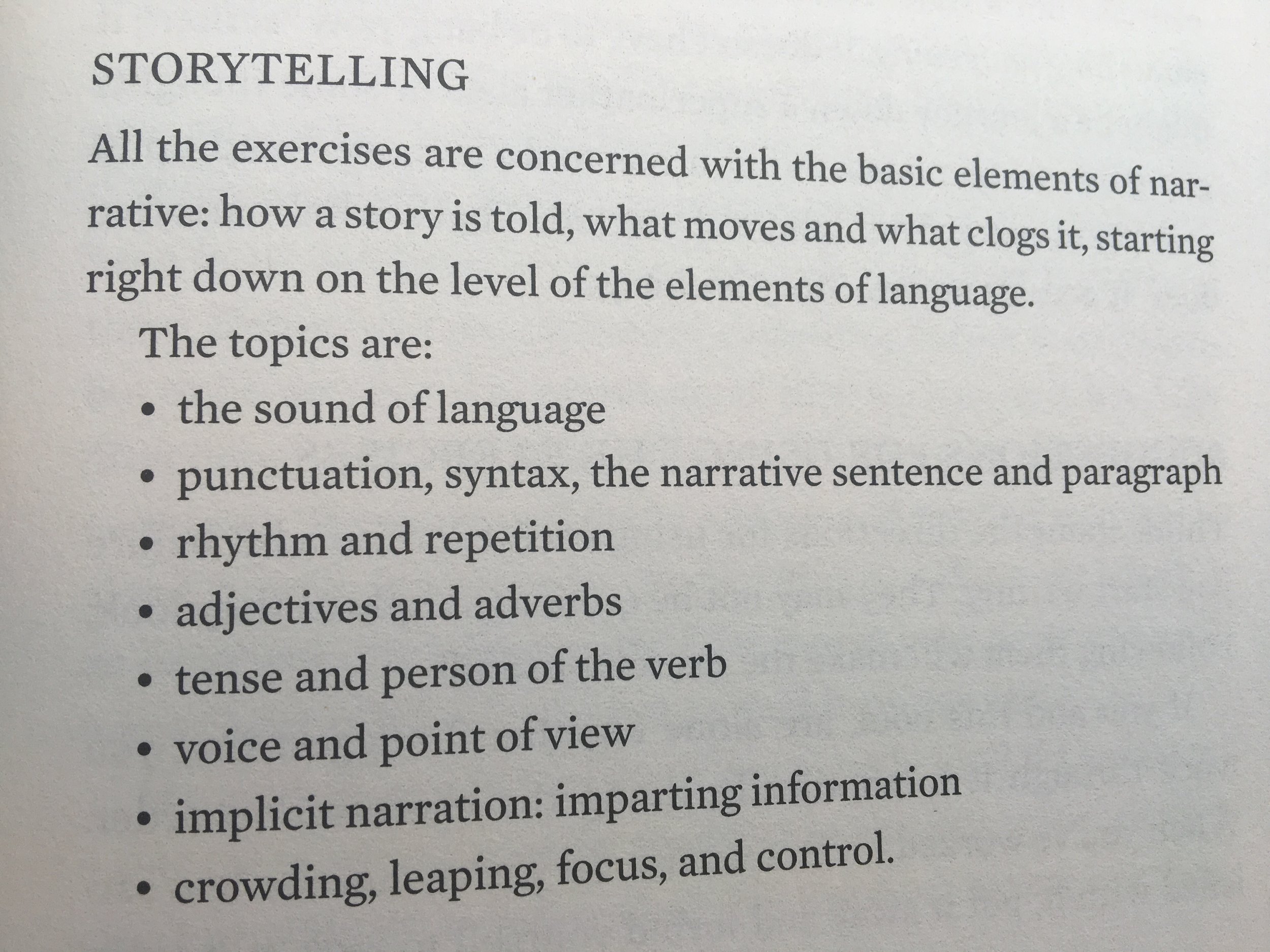
I'm back in training. I've been reading some of Le Guin's non-fiction work and her call for literature as an operating manual for life. She offers provoking thoughts and useful exercises on narrative story telling in her book, Steering the Craft.

FullSizeRender.jpg


I extract these thoughts from the book. I feel the book has excellent exercises for story telling. A touch less relevant for play and script writing (or poetry) which has its own structure but narrative is narrative and writing is writing.

"A skill is something you know how to do skill in writing frees you to write what you want to write. Craft enables art. That's luck in art. You can learn skill, you can earn it

I'm not going to discuss writing as self-expression, as therapy, or as a spiritual adventure. It can be all of those things, but first of all - and in the end to - it is an art, a craft, a making. And that is the joy of it.

To make something well is to give yourself to it. to seek wholeness, to follow spirit. To learn to make something well can take your whole life. It's worth it.

Whether you write fiction or non - narrative is narrative. Most writing classes or courses in school focus on expository writing, giving information, explaining. They talk about "expressing ideas" but not about story telling. Some of the techniques and values of expository waiting are irrelevant and even problematic in narrative writing; training in the elaborately irresponsible language of bureaucracy or the artificially impersonal language of technology and science can tongue-tie a storyteller.

Since narrative is what this is all about, try to make each exercise not a static scene but the account of an act or action, something happening. It doesn't have to be bang-pow "action"... what it has to do is move - end up in a different place from where it started. That's what narrative does. It goes. It moves. Story is change."

I will leave you with an exercise crucial for all writers. I don't know a single playwright who had never had to cut in order to hone her work. It is true of plays, poems and stories everywhere.

IMG_3107.JPG

Chekhov advocated it as well and his work both plays and short stories have stood the test of time.

FullSizeRender.jpg

Cross fertilise. Read about the autistic mind here and ideas on the arts here. On investing try a thought on stock valuations or Ray Dalio on populism and politics.

In Writing Tags Writing

JK Rowling Benefits of Failure

August 19, 2017 Ben Yeoh
From Wiki, JK Rowling reads, White House, Daniel Ogren (CC)

From Wiki, JK Rowling reads, White House, Daniel Ogren (CC)

JK Rowling on the benefits of failure and extolling the crucial importance of imagination. A thought on JK Rowling's 2008 Harvard commencement address.

“It is impossible to live without failing at something, unless you live so cautiously that you might as well not have lived at all – in which case, you fail by default.”

"So why do I talk about the benefits of failure? Simply because failure meant a stripping away of the inessential. I stopped pretending to myself that I was anything other than what I was, and began to direct all my energy into finishing the only work that mattered to me. Had I really succeeded at anything else, I might never have found the determination to succeed in the one arena I believed I truly belonged. I was set free, because my greatest fear had been realised, and I was still alive, and I still had a daughter whom I adored, and I had an old typewriter and a big idea. And so rock bottom became the solid foundation on which I rebuilt my life."

I'm assuming most in the world have heard of JK Rowling and subsequently have read her commencement address to Harvard in 2008. However assumptions can be dangerous. Only this month I've been repeatedly explaining the notions of clickbait and to be woke. Best not to assume too much.

So partly for my own personal archive and partly because I think on the chance that you haven't read it it's a wonderful speech all about the power of imagination, and the benefits of failure.

"What we achieve inwardly will change outer reality" - Plutarch

You can watch her below and extracts from her text follow. The complete text is here. It chimes with Ursula K Le Guin on literature as an operating manual for life and with Neil Gaiman, in his commencement address, on making wonderful, fabulous, brilliant mistakes; it even has much in common with Nassim Taleb's commencement address, though they be political opposites (they both admire Seneca).

.....Half my lifetime ago, I was striking an uneasy balance between the ambition I had for myself, and what those closest to me expected of me.

I was convinced that the only thing I wanted to do, ever, was to write novels. However, my parents, both of whom came from impoverished backgrounds and neither of whom had been to college, took the view that my overactive imagination was an amusing personal quirk that would never pay a mortgage, or secure a pension. I know that the irony strikes with the force of a cartoon anvil, now.

So they hoped that I would take a vocational degree; I wanted to study English Literature. A compromise was reached that in retrospect satisfied nobody, and I went up to study Modern Languages. Hardly had my parents’ car rounded the corner at the end of the road than I ditched German and scuttled off down the Classics corridor.

I cannot remember telling my parents that I was studying Classics; they might well have found out for the first time on graduation day. ...

I would like to make it clear, in parenthesis, that I do not blame my parents for their point of view. There is an expiry date on blaming your parents for steering you in the wrong direction; the moment you are old enough to take the wheel, responsibility lies with you. What is more, I cannot criticise my parents for hoping that I would never experience poverty. They had been poor themselves, and I have since been poor, and I quite agree with them that it is not an ennobling experience. Poverty entails fear, and stress, and sometimes depression; it means a thousand petty humiliations and hardships. Climbing out of poverty by your own efforts, that is indeed something on which to pride yourself, but poverty itself is romanticised only by fools.

What I feared most for myself at your age was not poverty, but failure.

...Ultimately, we all have to decide for ourselves what constitutes failure, but the world is quite eager to give you a set of criteria if you let it. So I think it fair to say that by any conventional measure, a mere seven years after my graduation day, I had failed on an epic scale. An exceptionally short-lived marriage had imploded, and I was jobless, a lone parent, and as poor as it is possible to be in modern Britain, without being homeless. The fears that my parents had had for me, and that I had had for myself, had both come to pass, and by every usual standard, I was the biggest failure I knew.

Now, I am not going to stand here and tell you that failure is fun. That period of my life was a dark one, and I had no idea that there was going to be what the press has since represented as a kind of fairy tale resolution. I had no idea then how far the tunnel extended, and for a long time, any light at the end of it was a hope rather than a reality.

So why do I talk about the benefits of failure? Simply because failure meant a stripping away of the inessential. I stopped pretending to myself that I was anything other than what I was, and began to direct all my energy into finishing the only work that mattered to me. Had I really succeeded at anything else, I might never have found the determination to succeed in the one arena I believed I truly belonged. I was set free, because my greatest fear had been realised, and I was still alive, and I still had a daughter whom I adored, and I had an old typewriter and a big idea. And so rock bottom became the solid foundation on which I rebuilt my life.

You might never fail on the scale I did, but some failure in life is inevitable. It is impossible to live without failing at something, unless you live so cautiously that you might as well not have lived at all – in which case, you fail by default.

Failure gave me an inner security that I had never attained by passing examinations. Failure taught me things about myself that I could have learned no other way. I discovered that I had a strong will, and more discipline than I had suspected; I also found out that I had friends whose value was truly above the price of rubies.

The knowledge that you have emerged wiser and stronger from setbacks means that you are, ever after, secure in your ability to survive. You will never truly know yourself, or the strength of your relationships, until both have been tested by adversity. Such knowledge is a true gift, for all that it is painfully won, and it has been worth more than any qualification I ever earned.

So given a Time Turner, I would tell my 21-year-old self that personal happiness lies in knowing that life is not a check-list of acquisition or achievement. Your qualifications, your CV, are not your life, though you will meet many people of my age and older who confuse the two. Life is difficult, and complicated, and beyond anyone’s total control, and the humility to know that will enable you to survive its vicissitudes.

Now you might think that I chose my second theme, the importance of imagination, because of the part it played in rebuilding my life, but that is not wholly so. ...

Imagination is not only the uniquely human capacity to envision that which is not, and therefore the fount of all invention and innovation. In its arguably most transformative and revelatory capacity, it is the power that enables us to empathise with humans whose experiences we have never shared.....

Unlike any other creature on this planet, humans can learn and understand, without having experienced. They can think themselves into other people’s places.

Of course, this is a power, like my brand of fictional magic, that is morally neutral. One might use such an ability to manipulate, or control, just as much as to understand or sympathise.

And many prefer not to exercise their imaginations at all. They choose to remain comfortably within the bounds of their own experience, never troubling to wonder how it would feel to have been born other than they are. They can refuse to hear screams or to peer inside cages; they can close their minds and hearts to any suffering that does not touch them personally; they can refuse to know.

I might be tempted to envy people who can live that way, except that I do not think they have any fewer nightmares than I do. Choosing to live in narrow spaces leads to a form of mental agoraphobia, and that brings its own terrors. I think the wilfully unimaginative see more monsters. They are often more afraid.

What is more, those who choose not to empathise enable real monsters. For without ever committing an act of outright evil ourselves, we collude with it, through our own apathy.

One of the many things I learned at the end of that Classics corridor down which I ventured at the age of 18, in search of something I could not then define, was this, written by the Greek author Plutarch: What we achieve inwardly will change outer reality.

That is an astonishing statement and yet proven a thousand times every day of our lives. It expresses, in part, our inescapable connection with the outside world, the fact that we touch other people’s lives simply by existing.

But how much more are you, Harvard graduates of 2008, likely to touch other people’s lives? Your intelligence, your capacity for hard work, the education you have earned and received, give you unique status, and unique responsibilities. Even your nationality sets you apart. The great majority of you belong to the world’s only remaining superpower. The way you vote, the way you live, the way you protest, the pressure you bring to bear on your government, has an impact way beyond your borders. That is your privilege, and your burden.

If you choose to use your status and influence to raise your voice on behalf of those who have no voice; if you choose to identify not only with the powerful, but with the powerless; if you retain the ability to imagine yourself into the lives of those who do not have your advantages, then it will not only be your proud families who celebrate your existence, but thousands and millions of people whose reality you have helped change. We do not need magic to change the world, we carry all the power we need inside ourselves already: we have the power to imagine better.

....And tomorrow, I hope that even if you remember not a single word of mine, you remember those of Seneca, another of those old Romans I met when I fled down the Classics corridor, in retreat from career ladders, in search of ancient wisdom:

As is a tale, so is life: not how long it is, but how good it is, is what matters.
 

The complete text is here. It chimes with Ursula K Le Guin on literature as an operating manual for life and with Neil Gaiman, in his commencement address, on making wonderful, fabulous, brilliant mistakes; it even has much in common with Nassim Taleb's commencement address, though they be political opposites (they both admire Seneca).

Cross fertilise. Read about the autistic mind here and ideas on the arts here. On investing try a thought on stock valuations. 

In Arts, Writing Tags Writing, Leadership

Writing Competitions

August 18, 2017 Ben Yeoh
IMG_2985.PNG

Several poetry, short story, art and a play writing competitions with deadlines coming up. The Oxford Brookes Poetry (28 Aug, deadline) competition. Aesthetica Creative Writing Award, both poetry and short story (31 Aug) and an art prize. Sunday Times EFG Short Story Award (28 Sep, need to be published writer). Manchester Poetry Prize for best portfolio of poems and the Manchester Fiction Prize for best short story (29 Sep). Taking Flight, play competition (30-60 mins, 1 Oct, Asian writers). The big one in poetry, The Poetry Society’s annual National Poetry Competition (31 Oct).   Get ready, get set - write - draw - go !


The Oxford Brookes Poetry  competition. 
The competition is open to both new and established poets aged 18 and over from across the globe and has two categories:
1) Open category (open to all poets aged 18 years and over)
2) English as an Additional Language (EAL) category (open to all poets aged 18 and over who write in English as an Additional Language
The winners of each category will receive £1000 and both runners up £200.

Aesthetica Creative Writing Award
The Aesthetica Creative Writing Award is an international literary prize that celebrates excellence in Poetry and Short Fiction. The prize is now in its 11th year, hosted by Aesthetica Magazine. With the aim to support and nurture new writing talent, it awards publication within an inspiring anthology to a shortlist of 60 writers, including a winner from each category.

The winners are also presented with further opportunities to expand their literary careers: £1,000 cash prize each, a consultation with literary agency Redhammer Management, a Full Membership to The Poetry Society, a subscription to Granta and books courtesy of Bloodaxe Books and Vintage Books.

  • Poetry entries should be no more than 40 lines
  • Fiction entries should be no more than 2,000 words
  • Works published elsewhere are accepted

They also run an Art prize.   There are two awards for entry: the Main Art Prize and the Emerging Art Prize. The Emerging Art Prize is open to current students and artists who have graduated within the last two years. The Main Art Prize is open to all, including those eligible for the Emerging Art Prize.

The 2018 Sunday Times EFG Short Story Award.
The prize, worth £30,000 to the winner, is an international award, founded in 2010, that is open to any story of up to 6,000 words written in English. Stories need to have been either previously unpublished or only published after 31 December 2016. Five other authors shortlisted for the award will each receive £1,000. The prize is administered by the Society of Authors. To be eligible, the author must simply have a record of prior publication in creative writing in the United Kingdom or Ireland.

The Manchester Writing Competition was established by Carol Ann Duffy in 2008. It offers the UK’s biggest literary prizes for unpublished writing and has awarded more than £135,000 to its winners. Each year two £10,000* prizes are awarded: the Manchester Poetry Prize for best portfolio of poems and the Manchester Fiction Prize for best short story. Designed to encourage and celebrate new writing across the globe the competition is open internationally to new and established writers.
> Manchester Poetry Prize - £10,000* 
> Manchester Fiction Prize - £10,000*

There is a play writing competition from Red Dragonfly. It's aimed for Asian writers in the UK only. They are looking for i) a thirty minute to an hour stage play, the subject of which can be anything you want – from something contemporary to more traditional folk and fairy tales- as long as it is family friendly – and we mean the whole family not just small children ii) The play should be written for a cast of up to five actors – although they can double up on characters if you want and iii) workable with a minimal set, however do not let this restrict your imagination – it's amazing what can be accomplished on a stage with very little. Applicants need to be over eighteen and based in the UK but otherwise we are truly open to hearing from anybody.

Finally in this summary, the big Poetry Society competition, it's open globally.  

  1. All entries are judged anonymously and the poet’s name must not appear on the poem itself.
  2. All poems must have a title and must not exceed 40 lines in length (excluding title). Entries can be on any subject.
  3. Poems must be the original work of the entrant.
  4. Entries must not have been published, self-published, published on a website, broadcast or featured among the winners in another competition before 31 March 2018.

Get ready, get set - write - draw - go !

Cross fertilise. Read about the autistic mind here and ideas on the arts here. On investing try a thought on stock valuations. 


In Arts, Writing, Poetry Tags Arts, Writing, Competitions

Life Operating Manual

August 16, 2017 Ben Yeoh
Still from Tales of EarthSea, PR handout, based on the Studio Ghibli interpretation**

Still from Tales of EarthSea, PR handout, based on the Studio Ghibli interpretation**

Ursula K Le Guin's Wizard of Earthsea impressed upon me the idea of words, the essence of words, as magic - as items of power. A brilliant story with a thread of understanding about the world we live in told through a completely other world. It made an impact early enough that I didn't understand "genre" so I could appreciate the work without knowing what I "should" or shouldn't like.

She also over her long career has written insightful pieces on the writing process, (a few words to a young writer, here 1968 rejection letter), creativity and Taoism (she has translated Lao Tzu -  saying:  “The Tao Te Ching is partly in prose, partly in verse; but as we define poetry now, not by rhyme and meter but as a patterned intensity of language, the whole thing is poetry. I wanted to catch that poetry, its terse, strange beauty. Most translations have caught meanings in their net, but prosily, letting the beauty slip through. And in poetry, beauty is no ornament; it is the meaning. It is the truth".

Here is her talking in 1975 at Worldcon.


Some of this is collected in Words Are My Matter: Writings About Life and Books, 2000-2016.

The piece (extracts below) on literature as a manual for life is worth the price of the book alone, if you measure such things in dollars and gold. Neil Gamain's commencement speech chimes although David Ogilvy takes the creativity for business much to Le Guin's despair I expect. The book reviews Le Guin gives are of more interest if you are a Le Guin fan.

The Operating Instructions (talk given at Oregon Literary Arts meeting in 2002)

"A poet has been appointed ambassador. A playwright is elected president. Construction workers stand in line with office managers to buy a new novel. Adults seek moral guidance and intellectual challenge in stories about warrior monkeys, one-eyed giants, and crazy knights who fight windmills. Literacy is considered a beginning, not an end. . . . Well, maybe in some other country, but not this one. In America the imagination is generally looked on as something that might be useful when the TV is out of order. Poetry and plays have no relation to practical politics. ...


... Literacy is so you can read the operating instructions. I think the imagination is the single most useful tool mankind possesses. It beats the opposable thumb. I can imagine living without my thumbs, but not without my imagination. I hear voices agreeing with me. “Yes, yes!” they cry. “The creative imagination is a tremendous plus in business! We value creativity, we reward it!” In the marketplace, the word creativity has come to mean the generation of ideas applicable to practical strategies to make larger profits. This reduction has gone on so long that the word creative can hardly be degraded further. I don’t use it any more, yielding it to capitalists and academics to abuse as they like. But they can’t have imagination. Imagination is not a means of making money. It has no place in the vocabulary of profit-making. It is not a weapon, though all weapons originate from it, and their use, or non-use, depends on it, as with all tools and their uses. The imagination is an essential tool of the mind, a fundamental way of thinking, an indispensable means of becoming and remaining human. We have to learn to use it, and how to use it, like any other tool. Children have imagination to start with, as they have body, intellect, the capacity for language: things essential to their humanity, things they need to learn how to use, how to use well. ...

Through story, every culture defines itself and teaches its children how to be people and members of their people—Hmong, !Kung, Hopi, Quechua, French, Californian. . . .

.... Literature remains comparatively, and amazingly, honest and reliable. ...

...Incoherent and commercialised and worm-eaten ... and hype and blather as it is, electronic publication offers those who read a strong new means of active community. The technology is not what matters. Words are what matter. The sharing of words. The activation of imagination through the reading of words. The reason literacy is important is that literature is the operating instructions. The best manual we have. The most useful guide to the country we’re visiting, life...."

Cross fertilise. Read about the autistic mind here and ideas on the arts here. On investing try a thought on stock valuations. 

** according to the Nerdist, the Ghibli film didn't use much of Le Guin's source material at all, but it did bring father and son back together again, so there is that.

In Arts, Writing Tags Writing
← Newer Posts
Follow me on LinkedIN
Contact/Support