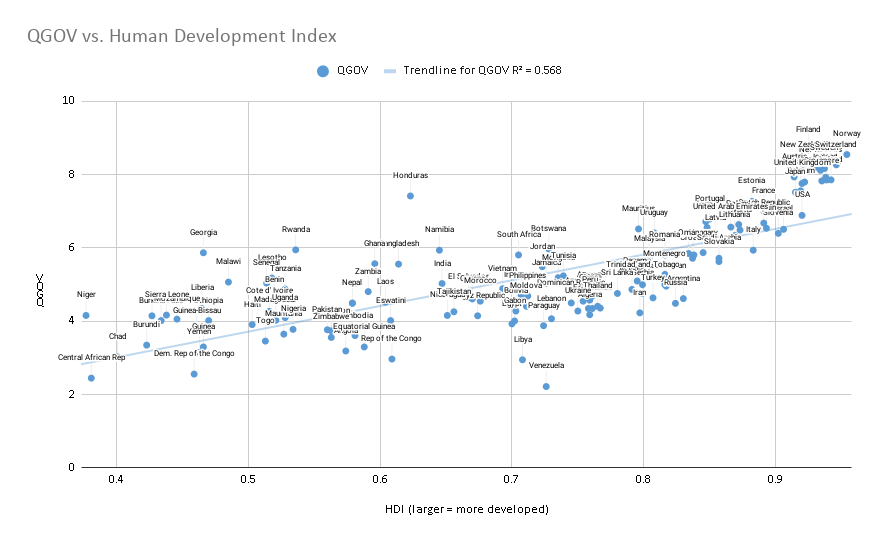
Comments on EDI, Life expectancy; observations and arguments for state capacity.
Given the weighting in the HDI that life expectancy has, it is unsurprising that QGOV also correlates better than SGOV for life expectancy.
While there are social and cultural determinants of health of which government would only be a component, I argue that it is still noteworthy that it is not size but quality of government here that seems to count.
Again given the weighting in the HDI for Education, it is again unsurprising that QGOV correlates better than SGOV.
Of note, Chile and Kazakhstan appear on education and to some extent life expectancy as higher perfomer small government countries to join Singapore and Ireland, Switerland.
I chose to examine education and health because in many countries there is on going debate as to the structure and capacity that governments should play in health and education markets.
This line of argument would suggest where countries do wish their governments to be involved then quality of that government or perhaps “state capacity” could be an important factor.
This is noteworthy in the UK where there is wide support for a National Health service across the political divide and also for state funded education providing the majority of the populations education.
Two other tentative observations. It is worth dwelling on where small governments seem to be doing well. I would note Singapore and South Korea and perhaps to an extent Ireland and Switerland. Those countries would be good examples of small, high quality goverments.
My own theory here is also the importance of social and cultural determinants of health and education.
For instance, it is unknown what the compliance rate for medications are in various countries. A higher drug medication compliance of cost effective genetic medications in Singapore (arguable driven by a social factor of listening to your doctor properly?!) or of the positive/negative health outcomes of effective elderly social care across countries are mostly unknown.
A second observation is the seemingly stronger slope in the high HDI nations. There may be many explanations for this and all the caveats expressed by Dolan also apply but it might be an intriguing provocation that quality of government becomes even more important in extending the progress of already highly developed countries.
Caveat
As Dolan notes there is considerable interation between SGOV and QGOV as larger governments have a tendency to be of better quality, but Dolan runs multiple regressions here:
“…simple correlations like this need to be interpreted with caution, as there are complex intercorrelations among multiple variables. In this case, we have a correlation of -0.42 between SGOV and QGov, that is, a tendency for larger governments to have a higher index of quality. We also have a correlation of 0.74 between QGOV and the log of GDP per capita (richer countries have higher-quality governments) and -0.48 between SGOV and the log of GDP per capita (richer countries have relatively larger governments).
Dolan can run multiple regressions which I do not have the capcity for, but Dolan concludes:
We can use multiple regression to untangle these interactions, using HFI* as the independent variable and using QGOV, SGOV, and the log of GDP per capita as the dependent variables. When we do so, we get a strongly statistically significant positive coefficient on QGOV and no statistically significant relationship at the 0.01 confidence level for the other two variables. The overall correlation is 0.79, essentially the same as for the two-variable relationship shown in the left-hand scatter plot above…”
I suspect multiple regressions would confirm similar and hope a profesional academic might look into this
Conclusion
I tentatively extend the work of Dolan on the size of government and quality of government to look at four further broad indices of 1) peace, 2) human development, 3) education and 4) life expectancy.
In all four cases, quality of government seems to be a more important factor than the size of government. This would be tentative evidence for theories that emphasise the importance of quality - perhaps state capacity - over the size of the state, where societies favour a state role in any given area.