Theory of change, depression drugs, fossil fuel divestment

In much of science practice, scientists form ideas and models and then test these models in the world. The more credible the model to other thinkers and the more the model can explain empirical results and - even better - predict new results that be tested then the more useful the model and the more weight we can give it in our thinking.


Many models can not fully explain what we observe in the world. 

Many observations have no good models for them.


How should we think about decision making faced with forward looking uncertainties? I argue we should put more weight on when we have plausible models. This is harder in social sciences than physical sciences but still should be considered. That said empirical data can guide where models seem inadequate.


I’m going to think about these cases and what they might say:


  • -Anti-depression drugs and their effectiveness or lack

  • -Germ and virus theory and mask wearing

  • -Fossil Fuel divestment , social political change strategies

  • -Quantitative Easing by central banks

  • -ThenDoBetter grants - catalyzing change


Anti-depression drugs and their effectiveness or lack of.

Prozac, known as fluoxetine, is a serotonin re-uptake inhibitor or SSRI and it was designed as an anti-depression drug based on a model for depression that scientists developed.


The basic model is called the monoamine hypothesis of depression and this theory s proposes that patients with depression have depleted concentrations of serotonin, norepinephrine (noradrelanline), and dopamine. 


It was conceived due to at least one line of evidence on the effects of reserpine on serotonin and catecholamines. Reserpine, an alkaloid extracted from the Rauwolfia serpentina, was utilized as a treatment for hypertensive vascular disease in the 1950s; however, reserpine was found to precipitate depression in some patients. The depression produced by reserpine was reversed after the treatment was terminated and following either rest or electric shock therapy (Additionally, reserpine was found to produce depressive-like effects in animals Reserpine was found to inhibit vesicular monoamine transporter, and as a result, depletes brain monoamines (i.e. serotonin and catecholamines), which provided evidence for the role of serotonin, norepinephrine, and dopamine in depression.  


Since its original formulation, scientists can see that this hypothesis can not explain many other observations (for instance that healthy patients who deplete monoamines do not become depressed).

Still, SSRIs were invented  as the NHS website suggests:

“ It's thought that SSRIs work by increasing serotonin levels in the brain.


Serotonin is a neurotransmitter (a messenger chemical that carries signals between nerve cells in the brain). It's thought to have a good influence on mood, emotion and sleep.

After carrying a message, serotonin is usually reabsorbed by the nerve cells (known as "reuptake"). SSRIs work by blocking ("inhibiting") reuptake, meaning more serotonin is available to pass further messages between nearby nerve cells.”

Without going into too much more detail, we know empirically that SSRIs relieve depression in a good number of people and can help prevent relapse. But we also know that they don’t work in  a good number of people and that they stop working for a good number of people. And we are not exactly certain why.


There is much we simply do not understand about depression and brain function.


So how does relate to masks?


We have a pretty good theory about how viruses are transmitted. They travel in aerosol droplets from the nose and mouth - from sneezing and coughing and breathing - and they are then breathed in by others. They can also go from nose to hand to someone else’s hand to nose, or from hand to object back to someone else’s hand. Although there is debate as to how long viruses can survive on objects and how easily this transmission occurs.


Scientists have a consensus on this. And so when thinking about mask use to prevent transmission it’s surprising with hindsight that this did not feature more prominently.


Of course now we can look back and also note how many Asian countries had mask wearing and how European and America seemed initially reluctant. Still, I think it would have been much better if those in policy making or decision making roles could have case back to whether there was an underlying model for whether mask wearing should work and then assess risk/benefit.


Here the model was and is very useful, but didn’t seemed to make an impact.


Central Banks have engaged in what economists call quantitative easing or QE. These are large scale purchases of asserts by central banks. Economists are debating as to how QE actually works in the real economy and they are unsure. At least I can say scientists are much more sure on how germ theory works than on how quantitative easing works.


It’s perhaps in the same area of dispute as depression drugs. There’s some empirical evidence but the totality of it can not be explained by one model we have. And the three models posed by QE are not universally agreed upon.  (Segmented Market, Preferred Habitat and Signalling theory).


There’s - to my sense - maybe more agreement amongst depression scientists about what can or can not be explained then there is amongst economists. I note this as important as the Bank of England publishes an in-depth report into QE - https://www.bankofengland.co.uk/independent-evaluation-office/ieo-report-january-2021/ieo-evaluation-of-the-bank-of-englands-approach-to-quantitative-easing


This brings me to fossil fuel divestment strategies and thoughts on activism.


In biology, scientists call the SSRI mechanism as a mechanism of action. It’s how we best think the SSRIs are working biologically.


In social science, scientists often talk about a “theory of change”. 


“A theory of change is a description of why a particular way of working will be effective, showing how change happens in the short, medium and long term to achieve the intended impact.”


Supposedly a good theory of change needs to be testable. THis is in common with good theories of biological mechanisms of action - but are often much harder to assess in social science.


To my mind - a purported biological mechanism of action - such as the SSRI one - has much in common with a theory of change mechanism.


I come across some activists who have not really thought about their theory of change. And if the conversation allows, I will suggest they do think about it. I will often stress I do not know myself what theory of change is correct because many of the social science ones can not be supported either way by the evidence.


Still - when you think about the theory of change around divesting as opposed to the theory of change around engagement and persuasion of a company - you end up with very different theories.


This was summarised in Ellen Quigley et al’s report for Cambridge University (H/T Dominic Burke).    


The divestment social-political theory of change:


“The political case for divestment rests on expectations that it will accelerate the pace of legislation in favour of an energy transition away from fossil fuels. It does so both through creating a political

environment more favourable to legislation and by weakening the political power of the fossil fuel industry.”


This to use a policy term “moves the Overton window” - this changes the range of policies acceptable to the general public to be enacted by governments.


It’s quite far away from anything involved with investing (Although there are separate arguments for financial risks and theories such as influencing cost of capital).


One can argue this makes the movement more of a moral movement - one that you can align with women rights, minority rights, and slavery abolition and mperhaps more recently apartheid campaigns.


Using aparthied in South Africa is a complex and interesting parallel. Many factors (some with parallels to engagement and diplomacy and some with parallels to embargoes and divestments) are impossible to disentangle with cause and effect in the outcomes.


As strict financial theorists would argue most fossil fuel financing is not made by trading shares but by primary financial capital raising from bank or government loans or share issuance, and such that trading in secondary equities.


Thus the theory of change for engagement or within system workers is to persuade companies to change models and change strategies and this is more effectively done via share votes and engagement. And it is to invest in primary innovation and primary capital formation for companies making the most positive impact.


Neither theory can easily be proven with the empirical evidence we have. There are some companies that have changed course. Some climate policies have come into place and some evidence that the overton window has moved - although more easily for innovation policy than for carbon taxes, it seems.


But, it does bring me back to which theory of change is more meaningful or more reasonable to you.


I am asked where do I stand. If there’s time I typically outline a number of these arguments for both sides and because it is complex and unproven, I hold the theories of change lightly. 


But, my theory of change is that it falls - by a complex dance and a good deal of luck and happenstance - that a number of individuals spark the change that leads to systems altering. These individuals lead others.


And so, this is one of the reasons behind my idea on ThenDoBetter grants. The focus is on individual grant giving with a huge dose of luck and happenstance to people who will make that positive change.


As a coda thought. There are no universal theories of autism. The three main ones (central coherence, theory of mind, executive function) can explain certain aspects of autism but fail in many other aspects.  We have (in my view) poor models of autism (although not zero models, thus we can reject “refrigeration” and other catastrophically bad theories) and so we should hold lightly too much strong form advice here.


Quigley report:

https://www.cam.ac.uk/sites/www.cam.ac.uk/files/sm6_divestment_report.pdf 

How effective are anti-depressants:

https://www.ncbi.nlm.nih.gov/books/NBK361016/#:~:text=Studies%20involving%20adults%20have%20shown,within%20one%20to%20two%20years.

Brief history of anti-depressants: https://www.ncbi.nlm.nih.gov/pmc/articles/PMC4428540/


Theories on QE

https://www.stlouisfed.org/on-the-economy/2017/november/economic-theory-quantitative-easing


Was 2020 a turning point year?

Why do I think 2020 may be a rare turning point year?
I still think there’s a decent chance that COVID will fade from memory and we will have learnt little (this would make it like Swine flu). But, I think that chance sits around 30% and moving lower. This is partly due to the length of time COVID will be affecting us and partly due to our response both innovation-wise and public health wise.

On the positive front we have had many science innovations not least on the vaccine and biomedical front:  mRNA technology looks set to prove long-term robust to make many kinds of vaccine. We have a malaria vaccine in late stage testing, Deepmind/AI has made advances in protein folding modelling, and new molecular entity drug approvals (excluding vaccines) was c. 51 this year in the US, which is in line with the last few years in terms of therapeutic innovations. With gene-editing technology and our increasing knowledge and comptuting power, biomedical advances for the next 10-20 years look promising to me.

Environment-wise: We’ve had China, Japan, South Korea commited to carbon net zero. Battery technology has continued to improve. Solar power is the cheapest form of energy in many places. Even Nuclear (mini) and fusion technology has continued to improve. Apple has joined the electric vehicle / driverless car race. 

Governance-wise: We had fiercely contested US elections that have essentially been peaceful and robustly managed given that over 161 million Americans voted. UK and EU managed to agree a Brexit trade deal. 

My guess is that certain people will be inspired by science and innovation as having some answers to our challenges that will make them place more bets here and invent more valuable things that will improve human welfare and the environment. That COVID has triggered an enhanced ability to work out of the office should help bring more productivity and people to work and develop and, hopefully, this should also bring about better welfare.

Many of these improvements are slow-moving - like our overall improvements in human life expectancy and welfare. Many of us both misjudge how far we have come, and perhaps if we understand our progress we misjudge the challenges which are still great.

But we will need both parts. To understand where we have made progress, where we still have challenges and to use the opportunities COVID has given us to do better while trying to defeat its catastrophic impact.

That's not to downplay the awfulness of COVID. That's with us. But how we react is still up to us.

I remain more worried about creative arts practitioners.While over the long-term creative industries have typically bounced back from hard times, I think 2021 will continue to be hard and I see many brilliant creatives having to leave the arts and related work. It’s hard to measure the value of arts and the financial rewards are low for the majority. There is little joy in a future generation of creative work when this generation is so hit.

Speed, advantages and considerations, John Collison interview

A recent interview with Stripe co-founder, John Collison, has plenty of food for thought (link end) especially around what makes successful start-ups, businesses and what we can learn from congleremates, being an outsider to America and technology. One item raised, I’d like to discuss is:

Speed

This is the idea of speed as an under-recognised competitive advantage and a defensible one. Collison applies to business and start-ups but I think it can be applied to make areas of life. In particular, I am thinking of theatre making and personal life decision making.

Jeff Besos has articulated a related idea on what he calls Type 1/Type 2 decision making. A few decisions are heavy weight, very hard to reverse course and require considerable due diligence before making. These decisions are rare and more rare than most believe. (In this framework) Most decisions should be made fast because they are not heavy weight, not hard to reverse and the answers may only come from experimenting with the choice. (This leads to the notion of “Disagree but commit”  another Besos/Amazon idea that you might disagree but that shouldn’t impede the decision being made fast.)

Collison makes a point I believe to be true but is seldom raised.

“Speed” is attractive to a certain type of person. This type of person - and for business this is typically an employee - can have particular creative qualities (and often not fit in well with the bearocratic nature of big companies - and slow moving nature of some).

While Collison talks about start-ups and business I think you can apply this to the arts and theatre making. Some theatre makers like to be speedy, make fast decisions, create work quickly and show it fast and early. Others are slower in approach. This extends to organisations.

The rule of thumb might be that larger organisations are less speedy but Collison makes the point that this is not necessarily so. Collison argues that Facebook and Google/Alphabet can very fast when they commit. Amazon as well.

However, it does seem true to me that many large organisations do lose this quality.  There are intersectional reasons for this: culture, growing risk aversion, complexity, number of humans involved and differing goals.

But for large organisations that can keep this ability and have it infused in their culture, it can be an important advantage. This idea is related to Jeff Besos stating his wish for Amazon to always be a “Day 1” company.

If  we believe it’s not merely size of company, can we highlight other aspects? I mentioned culture (set by the top people and embodied by all people) as important but more complex to set. I think size of team is a controllable item.

Collison also suggests this. He argues that a small team (even a solo person) can often make breakthroughs or create solutions where 300 person teams fail. The academic work on the nature of innovation - incremental or step change - and size of team is mixed but I think Collison has observed a general truth about small teams.

Certain managers in certain large organisations understand this, they assemble small teams typically with people who tend towards the effective and speedy spectrum, and they task them with solving something important.  

That’s not to confuse when a heavy weight decision needs to be made. But, a decision on whether to marry is seldom, a yes/no on a short drink date should probably be made fast and not agonised over.

Processes in many organisations are not geared to helping speed. Mostly they are geared to minimising risk. And while risk mitigation is a consideration an error of omission is many times a more serious error. 

One example is how Netflix simplified the expense policy for the goals of speed and simplicity.

“…

  • Our policy for travel, entertainment, gifts, and other expenses is 5 words long: “act in Netflix’s best interest.”

  • Our vacation policy is “take vacation.” We don’t have any rules or forms around how many weeks per year. Frankly, we intermix work and personal time quite a bit, doing email at odd hours, taking off a weekday afternoon, etc. Our leaders make sure they set good examples by taking vacations, often coming back with fresh ideas, and encourage the rest of the team to do the same.

  • Our parental leave policy is: “take care of your baby and yourself.” New parents generally take 4-8 months.

…”

A complicated expense policy is mostly there to try and mitigate risk rather than increase the time and productivity of its people.

Small organisations mostly do not bother with an expense policy and rely on trust and common sense.

I find this a telling observation. Small teams and small organisations can rely on trust and knowing. Big organisations lose that ability and rely on “policy”. 

It’s false reassurance. Policy won’t save you, if you don’t have the trust of people.

If you understand yourself enough to know what frustrates you and how much you like speed or not, this can set you up for the type of work and creative environments you should try and find. Perhaps that’s why hubs like around San Francisco are full of people who think like this.

There is so much about life which is due to uncontrollable chance factors or factors which may as well be chance. Again, if you understand or accept that view that about life then that may weigh on how you make decisions and view of risk.

When creating theatre, I think it does say something about the management of people and size of team that can be speedily managed or not.

If you are in the mode of creating a business, you might want to spare some thoughts to the culture you want to be developing and whether speed will be one of your advantages and if speed is part of your advantage, how to keep it.

Links:

Netflix Culture, policies and explantions

Interview with John Collison

The 1997 Amazon letter about decisions

Michael Liebreich on climate post-COVID

Michael Liebreich on climate post-COVID: "...Epidemics are not the only systemic risks to which we have been oblivious. In the run-up to the Great Financial Crisis we were oblivious to the systemic risks to our financial system posed by extreme levels of leverage and risky, opaque derivatives. And most people are still complacent about the systemic risks to our planetary environment posed by thoughtless economic development. Is it fanciful to hope that that as a result of Covid-19 the world pays a bit more attention to those urging us to respect our planetary boundaries, and a bit less to those pretending they do not exist?

In summary: Covid-19 is causing a massive drop in emissions this quarter, perhaps as much as 20%; after that, emissions will rebound, but remain significantly down until a vaccine enables a full recovery; even after that, they may well remain depressed for some years by an economy again hobbled by a colossal mountain of debt; and in the longer term, the stickiness of some of the new behavior, business models and technologies will certainly accelerate the transition to a low-carbon economy. Out of this terrible period, some good will come..." 4 min op-ed piece for BNEF here.

COVID, Policy: vaccine acceleration proposal, treatment accelration proposal

  • $1.3bn - $2bn for a 9% up to 40% chance to save 1.2 million US lives earlier

  • $700m, 9%+ chance save 200,000 UK lives 

  • Make a significant investment to scale up current vaccine trials

  • Chance mass vaccinations once safety data is passed

  • Chance mass antibody protections? Accelerate treatment trials.

  • Flatten the curves maths uncertain, vaccine and treatments good bets in any scenario.

  • Treatment/trial protocols should be set up now and accerelated after positive safety before full phase 3 trials

Please also see end disclaimer and draft open letter on this idea.

Is it not possible to have a vaccine into the field in 6 to 12 months, rather than 18 to 24 months?

I think it should be with some money ($1bn to $2bn), will power (some companies will have to work hard) and a change/boost from regulators (typically they’ve not allowed drugs on to the market until definitive efficacy is shown, though have in certain cases eg cancer, as they are risk averse) . I don’t even think incentives need to be changed much in this case, although a re-think here would help for the future.

My proposal:

-start mass scale up of leading vaccines now

-if safety trial is positive (April we might know but there should be some data already available)

-then proceed to vaccinate the 60m elderly in USA

If safety trial has passed this has in the range of a 20% to 40% chance of working (my estimate). Note, BIO suggests 24% success for a phase II vaccine and 16% for a phase I vaccine. 

Best case scenario: 1.2m+ lives saved

Base case scenario: no change, $1.2bn spent but manufacturing technology and other assets built 

There is no worse scenario if safety has passed except for tail events and resources used.  I guess small chance that somehow this messes up a future vaccine,, but seems unlikely.

Getting 60m vaccinations is tricky but they can also get the flu shot at the same time which should prevent flu deaths in any case. 

Details:

Moderna  has already submitted a vaccine candidate using its mRNA technology. It’s currently being tested in safety trials. There are several other vaccine candidates, (cf. Inovio, Sanofi, J&J, GSK) but the speed is too slow - and it might not need to be this slow.

There is time and money needed to scale up manufacturing in case of success.  This could be accelerated for $500m, if started now. That investment could be used to negotiate, say, a $15 price for the vaccine. CDC pays $18 for a flu vaccine. 

So ball park for US that would be a $1.4bn investment. 

While the UK has only 12m elderly, maybe it could go halves with the US.  Still the same calculation for UK is about $700m.

Note, CEPI (Coalition for Epidemic Preparedness Innovations) has suggested $2bn for for up to 3 candidates to go forward finally past phase 3 (starting with 8 or so in phase I). So, about $1bn for one drug seems doable, at speed. Now the mostly traditional system, will have a good probability of success but it will be slow. So I’m suggesting a $1bn, 6% chance bet on one or 2 candidates now, for a chance for a vaccine in 6 months - that’s 12 to 18 months before the likely CEPI process. (We also know with some recent fast success in cancers. cf. Roche, Merck PD-1s, Novartis’ Gleevec some of this is possible at speed)

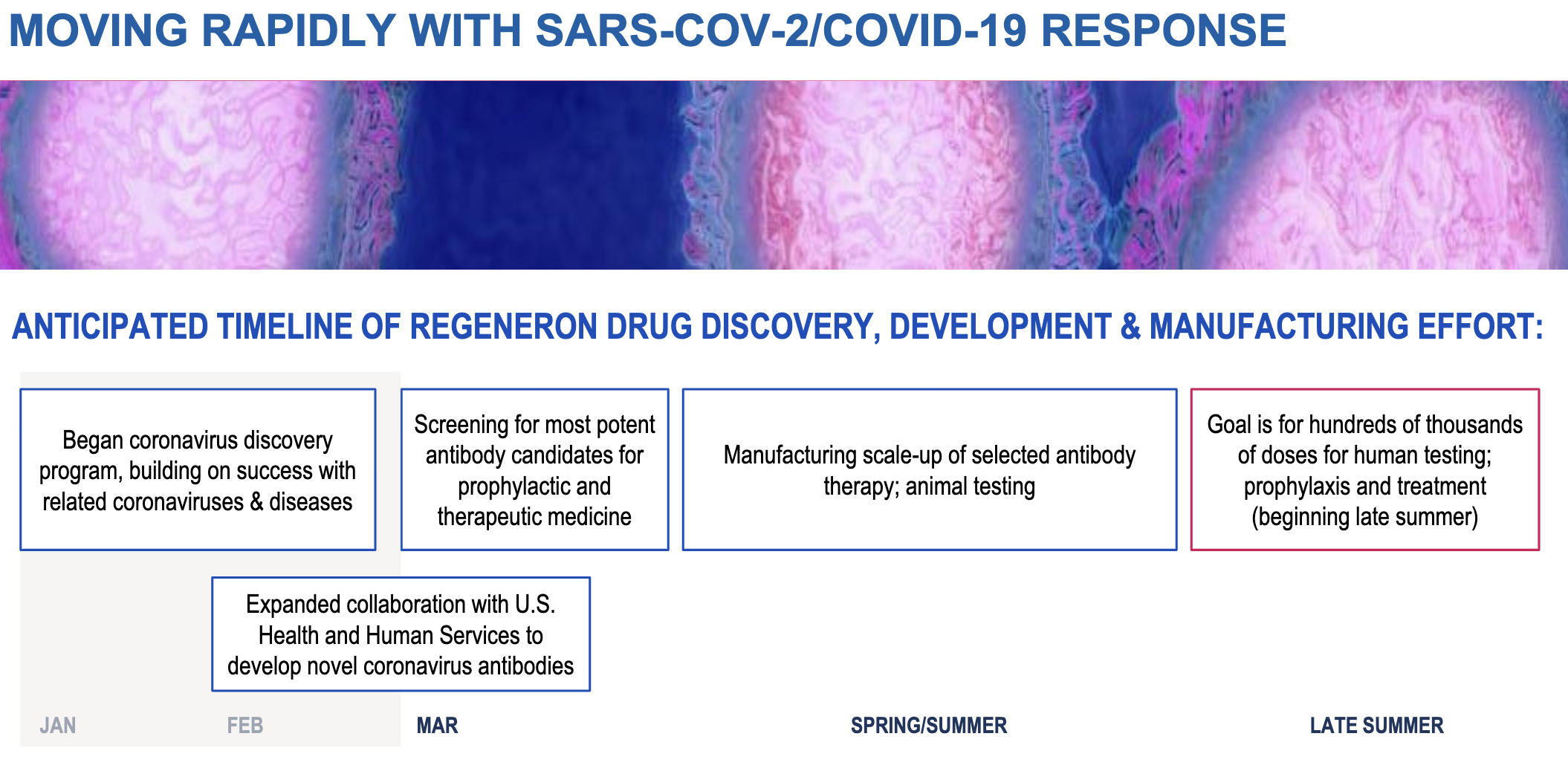
I’m also suggesting we allow drugs once they pass safety (or have passed safety), to be allowed into the field (this would cover Regeneron’s possible treatment, it would cover Chloroquine, baricitnib and ruxolitinib - these have already passed safety in other indications; it would be resmedivir as well)

Source: Regeneron (Cowen Conference, March 3)

Source: Regeneron (Cowen Conference, March 3)

Also, note there might be antibody treatments - this would be Regeneron’s approach. It won’t have antibodies ready until summer, but once ready, after a short safety trial, it might be worth going to dose the elderly. So say doeses ready in August, safety trial Sep - get it ready now - and start dosing in October. This could be expensive but only in the order of $2bn to $8bn depending on price. Now, in October we won’t know efficacy, but if safety is basically clear, then again we have a 20 - 40% chance of success albeit at a higher cost (as antibodies are more expensive).

Vaccine probablity of success

Vaccines have a 6% percent of success once in pre-clinical trials (base line stat) and around 16% when in phase I.  Investors use a range of 1% to 16% chance of success typically for Phase I drugs.  Risk is often bucketed for (a) safety (b) efficacy and c) regulatory.

There are plus/minus reasons to vary the risk of a COVID vaccine.  Regulatory risk is lower than average. Reasonable people can argue for safety/efficacy risk. The mRNA technology is new, but we do have the virus genome. We know how to make flu vaccines very successfully, so it’s proabably a matter of time and investment rather than completely new invention/innovation needed.

In any event, this is a >0 success rate, and a ball park 9% is reasonable for a novel phase I vaccine.

Vaccine and treatment idea details

Manufacturing in advance.  This needs to start now as scale will be needed.

Trial for efficacy now. Ask for volunteer elderly, maybe healthcare worked and start the phase 2/3 test immediately in April/May. This is if you simply can’t push through vaccines when not yet tested.

If you scale up the money, you can run it on all 8 or so most viable vaccines, $8bn should be enough to take through an accelerated phase 2/3 + manufacturing if there is regulatory and company willing.

There are 80 or so drug treatment candidates identified by WHO. (see sources end)

We should start with drugs already approved and get them ready for trial in the field.

This would include chloroquine (already being used by China) and baricitinib (as identified by AI processes), China is running trials using ruxolitinib. These are treatments rather than preventative but still useful in curing patients and getting them out of ICU.

The practical maths of flattening the curve

The UK needs to keep ICU cases down to approx 1000 (range up to 2000).  This means peak diagnosed confirmed cases at 20,000. (Range 10K to 40k).  The measures required to do this in the UK given current doubling times are have quetionablt in feasibilty Some modelas have. UK reaching 20,000 cases between 21 to 90 days. And an ICU case may stay in ICU for 3 weeks+ depending on death or recovery.  So keeping capacity at the ICU level is going to hard. We may be able to produce cheap ventilation and free up capacity, but it might be tricky.

That’s why accelerating a vaccine and treatments are a good bet, as they might help get in before the peak or help people out of ICU.

Tough maths of elderly deaths

Let’s look at some other brutal maths. 1 year or 2 year infection rate estimates might range from 20% to 70% of the population. Swine flu had a 20% infection rate and 150K to 575K people died (CDC data). Swine flu also circulates every year now since 2009.

A 20% infection rate seems very plausible. The case fatality rate (this is for when you are assigned as a case and so doesn’t include non-symptom or mild cases that don’t get reporting) is very hard to know.

These are the brutal maths for the UK and Italy.

Italy has about 60m people and >22% are over 65 —> over 12m elderly.

If 20% are diagnosed —> 2.4m and at 4% CFR —> 96,000 deaths. It’s easy to see how this might range up to 200,000+ easily with double diagnosis/CFR.

In the UK, it’s about 18% of 67m —> this is also 12m elderly. The maths is the same, if 20% are diagnosed —> 2.4m and at 4% CFR —> 96,000 deaths.

Politics of this bet

In UK, US many conservative / Republican voters are elderly >65. There are more of these Rep voter >65 (and this reverses for under 30s).

So in particular for Trump and Johnson, this would be a political calculus to consider if they wish.

Alternatively, some have argued that losing “unproductive” >65s might make for a more productive economy with lower social cost burden. Eeek.

The Future:

Pandemics are very likely (over 90% chance) to occur (again) over the next 50 years and likely over 100 years+ time frames. This pandemic was predicted by pandemic experts.

This is because:

-humans are increasingly interconnected at speed

-the way we treat/breed animals is not changing any time soon

-wet markets and similar not likely to change soon (though I think in eg China there will be a crack down)

-current viruses/germs eg influenza, pneumonias have been around for 1000s years

-virus/germs will constantly mutate

-containment will slow, likely never stop, transmission

What to do about future pandemics

-cultural learnings eg greetings

-innovation

We can slow transmission and in small cases potentially even stop by a change in cultural norms. We know the behaviours - washing hands, hygiene, don’t shake hands, cough into elbow  - but compliance can be greatly improved. This is inexpensive. Still, it is unlikely to stop all future pandemics. It’s worth recommending more strongly. Sanitation has already given use huge gains here and can gives us further gains.

That leaves us with treating pandemics and vaccinating once pandemics start. This is a question of innovation.

Incentivising Innovation

The market arguably has inefficiencies with dealing with i) rare diseases and ii) developing world diseases and iii) diseases that have not occurred, but we can predict are likely to occur.

This is due to those markets being risky and/or commercially small and/or commercially small risk-adjusted (a market might be worth $2bn but at 1% chance of success, $20m risk-adjusted would be of small value).

Policy solutions that have (at least partially) worked have been  a) granting longer/extra intellectual protection for rare diseases and b) agreed forward purchasing contracts for developing world diseases.

(a) Has helped areas such as rare genetic diseases, and multiple sclerosis (and other classified rare diseases) in the developed world (mostly) and 

b) has helped in malaria and certain other developing world diseases (where commercial markets are smaller) - forward buying by the Gates Foundation amongst others.

Such mechanisms have mostly failed in I) developing new antibiotics against resistant strains, II) certain other developing world diseases,  III) pandemics.

One negative factor in this is state appropriation of (mostly) private innovation. Rich countries eg US have been guilty of this as much as poor countries. The US essentially disregarded protection (or threatened to break the patents) on anthrax treatments in seeking to stockpile such medications cheaply. [https://www.wsj.com/articles/SB1003966074330899280 ]

This causes a large disincentive to work on vital areas, if profit-seeking entities will lose out on their R&D development costs for such treatments.

I would propose (as others have done in various guises)

-partial speed up of regulatory response for areas of unmet medical need

-international “state capacity” in antiviral, antibiotic, mRNA, pandemic research

-forward purchase fund for pandemic vaccines and medications

Partial speed up of regulatory response for areas of unmet medical need

The gold standard in medical research are randomised controlled trials (RCTs). They are costly and slow, but typically generate the most robust results.

For low commercial value areas, RCTs (and previously trials needed before RCT) are too costly for entities to perform give the risk. 

But, mostly health regulators will need RCTs before approval of a drug to be able to know the risk/benefit of a medication vs standard of care.

This has led some thinkers (eg Peter Thiel) to argue that regulators need to change or relax standards to allow quicker and more innovation on to the market. The challenge is that this may let onto the market ineffective treatments that cost lives or damage the credibility of the system.

One compromise would be to let medications on to the market where - in a controlled fashion - when there is enough evidence of safety/efficacy but no RCT. A full approval would be contingent on  future RCTs being performed in a reasonable time frame else the drug would be with drawn from the market. The drug would also be withdrawn if the RCT fails.

If medications for areas of high unmet need - for instant pandemics or other diseases with limited treatment options - would be released this way, the net benefit would be positive.

Industry would pay for such a faster service, and this could cut drug development time in half.

International/national “state capacity”

Faster regulation alone would not help unless there were medications to test.  Given the long and uncertain cycles for viral pandemics, it’s beyond the risk tolerance for many private entities. There are further complications because mutations might mean the plan A vaccine proves to be relatively ineffective and has to be made again under plan B.

However, I believe this is an area where even libertarians or perhaps “state capacity” libertarians might concede a non-private institution or set of institutions might be useful.

Essentially, I would be arguing for a form of Health ARPA where a part of the HARPA is focused on pandemic anteviral research, and antibiotic research and possibly other areas of unmet medical need. This is a sibling idea to the NIH but more targeted at likely pandemics.

If such an organisation had capacity to response quickly to evolving pandemics, then it should be able to share royalties with any other parties needed to scale medications to commercialisation, if it needed private partners to help scale quickly.

There should be positive spillover (cf NIH) in the years when no pandemics occur.

Forward purchase fund for pandemic vaccines and medications

Now (A) We have an organisation that can respond quickly with a new medication, and (B) a regulatory process which can speed through medications for high unmet need (eg pandemic) but how will we pay and keep incentives especially if we need multi-stakeholders to develop the medication.

This is where a forward purchasing fund or contract comes  into play. This fund acts as a guarantee that a certain amount will be paid for the innovation in a swift manner. This is where CEPI already sits and comes in and the Gates Foundation (along with Mastercard and others) have made a sister CEPI for COVID specifically. I do note the US govt has approved funding quickly on COVID, but still better to have it already in place.

But, stronger and wider funding for CEPI (and I expect this will happen) would be a good development.

Conclusion

Given pandemics will re-occur, we should look to set up capacity to deal with pandemics, regulation that can be swift and responsive and a fund to guarantee a fair price for innovation and set incentives accordingly

Post Script: It turns out Bill Gates haas also written on this topic and he many similar ideas and sources (and talks more about infrastructure build) examples of certain pandemic preparation here. https://www.nejm.org/doi/full/10.1056/NEJMp2003762

Other Sources:

On some COVID maths https://www.thendobetter.com/investing/2020/3/13/covid-brutal-maths-and-counter-factuals

On political age split: https://www.people-press.org/2016/09/13/2-party-affiliation-among-voters-1992-2016/

Moderna in trials: https://investors.modernatx.com/news-releases/news-release-details/moderna-ships-mrna-vaccine-against-novel-coronavirus-mrna-1273

On the CEPI funding call https://cepi.net/news_cepi/2-billion-required-to-develop-a-vaccine-against-the-covid-19-virus-2/

On Regeneron’s approach: https://newsroom.regeneron.com/static-files/2b0c3227-defd-4b84-814a-8519c89e103f

ON WHO list of treatment candidates:

https://www.who.int/blueprint/priority-diseases/key-action/Table_of_therapeutics_Appendix_17022020.pdf?ua=1


Disclaimer and open letter:

Can you confirm the UK will be investing in COVID therapy research and will run trials this year, as according to the clinical trials database no trials are running?

Can you explain why, we should not significantly enhance UK treatment development protocols and potentially gain effective treatments or prophylactics this year, given certain biopharma companies are already testing treatments?

My thinking and letter  on this is below.

Dear Patrick Vallance + UK team,

A safe vaccine or treatment with up to 40% chance of efficacy (maybe more) could be ready within 12 months. You’ve stated a vaccine is highly unlikely this year. This might be true under a traditional timeline, but if we invested under novel protocols we might significantly beat this.

(We met when you were at GSK and I know you have detailed knowledge of the traditional pathways, but I’m asking that you think about evoking an accelerated pathway).

Moderna has a vaccine in phase I safety trials (running as of March 2020). (There are others too.)

Regeneron has an antibody based programme that will have treatment available for trials in late summer.

If these trails show safety - there could be reasonable evaluation by May for the Moderna vaccine  - then perhaps it is worth evaluating the risk of scaling up manufacturing and performing dosing in the elderly population? (Say, 20% - 40% chance of efficacy, this may be a good risk adjusted investment.) I think a £500m to £1bn investment could achieve this.

If this is not acceptable,  then at least running an accelerated phase I/II/III trial here in the UK? I feel sure you would find the necessary volunteers.

This way, we may be able to accelerate a successful vaccine by up to 12 months from historic timelines. Or the antibody treatment could be available early 2021 or in 2020 under compassionate use. Is this not worth a chance?

We have evidence that several drugs might be effective treatments:

remdesivir (trials in China)

The anti-Il-6, Tocilizumab  to treat cytokine release syndrome, a COVID-19 complication (China approved)

Chloroquine (China approved)

Baricitinib, Ruxolitinib (Rux is trialing in China already)

and many more.

Can you confirm the UK will be investing in this research and will run trials?

Now is the time to try fast and large scale innovation for a treatment and vaccine, and I feel sure that the UK could help lead the way here.

I wish you and your team every success.

Benjamin Yeoh

Notes and Sources:

Ben Yeoh is a healthcare investor with 18 years experience but is not a virologist or infectious disease expert. This is written in a personal capacity. This is an open letter to challenge traditional thinking based on biotech conversations that suggest accelerated timelines for treatments are possible. Ben believes government advisors should investigate this line of action. This is a personal view with no organisational endorsement. The view is made in good faith and should be investigated by those with expert knowledge. I suggest these ideas for public health reasons and there is no endorsement or not of any company mentioned for investment purposes.

On Moderna’s approach:

https://investors.modernatx.com/news-releases/news-release-details/moderna-ships-mrna-vaccine-against-novel-coronavirus-mrna-1273

On Regeneron’s approach: https://newsroom.regeneron.com/static-files/2b0c3227-defd-4b84-814a-8519c89e103f

See slide 22.

Identification of baricitinib (and ruxolitinib) as treatments:

https://www.thelancet.com/journals/lancet/article/PIIS0140-6736(20)30304-4/fulltext

WHO database of drug treatments referencing ruxolitinib already in trials:

https://www.who.int/blueprint/priority-diseases/key-action/Table_of_therapeutics_Appendix_17022020.pdf?ua=1

Details on Tocilizumab being approved in the 7th updated diagnosis and treatment plan for COVID-19 issued by China National Health Commission (NHC) on March 3, 2020 and the drug being in clinical trial.

https://www.gene.com/covid19

Speculative ways of thinking about treatment + vaccine: https://www.thendobetter.com/investing/2020/3/14/covid-policy-vaccine-acceleration-proposal

Further details:


Vaccine probability of success

Vaccines have a 6% percent of success once in pre-clinical trials (base line stat) and around 16% when in phase I.  Investors use a range of 1% to 16% chance of success typically for Phase I drugs. Risk is often bucketed for (a) safety (b) efficacy and c) regulatory.

There are plus/minus reasons to vary the risk of a COVID vaccine.  Regulatory risk is lower than average. Reasonable people can argue for safety/efficacy risk. The mRNA technology is new, but we do have the virus genome. We know how to make flu vaccines very successfully, so it’s probably a matter of time and investment rather than completely new invention/innovation needed.

In any event, this is a >0 success rate, and a ball park 9% is reasonable for a novel phase I vaccine.

Vaccine and treatment idea details

Manufacturing in advance.  This needs to start now as scale will be needed.

Trial for efficacy now. Ask for volunteer elderly, maybe healthcare worked and start the phase 2/3 test immediately in April/May. This is if you simply can’t push through vaccines when not yet tested.

If you scale up the money, you can run it on all 8 or so most viable vaccines, $8bn should be enough to take through an accelerated phase 2/3 + manufacturing if there is regulatory and company willing.

There are 80 or so drug treatment candidates identified by WHO. (see sources end)

We should start with drugs already approved and get them ready for trial in the field.

This would include chloroquine (already being used by China) and baricitinib (as identified by AI processes), China is running trials using ruxolitinib. These are treatments rather than preventative but still useful in curing patients and getting them out of ICU.

Costs

Moderna  has already submitted a vaccine candidate using its mRNA technology. It’s currently being tested in safety trials. There are several other vaccine candidates, (cf. Inovio, Sanofi, J&J, GSK) but the speed is too slow - and it might not need to be this slow.

There is time and money needed to scale up manufacturing in case of success.  This could be accelerated for $500m, if started now. That investment could be used to negotiate, say, a $15 price for the vaccine. USCDC pays $18 for a flu vaccine. 

While the UK has only 12m elderly, maybe it could go halves with the US.  Still an approx $1bn to $2bn investment per likely treatment candidate is viable and would potentially accelerate treatment into 2020.

Note, CEPI (Coalition for Epidemic Preparedness Innovations)  has suggested $2bn for for up to 3 candidates to go forward finally past phase 3 (starting with 8 or so in phase I). So, about $1bn for one drug seems doable, at speed. Now the mostly traditional system, will have a good probability of success but it will be slow. So I’m suggesting a $1bn, 6% chance bet on one or 2 candidates now, for a chance for a vaccine in 6 months - that’s 12 to 18 months before the likely CEPI process. (We also know with some recent fast success in cancers. cf. Roche, Merck PD-1s, Novartis’ Gleevec some of this is possible at speed)

I’m also suggesting we allow drugs once they pass safety (or have passed safety), to be allowed into the field (this would cover Regeneron’s possible treatment, it would cover Chloroquine, baricitnib and ruxolitinib - these have already passed safety in other indications; it would be resmedivir as well)

Also, note there might be antibody treatments - this would be Regeneron’s approach. It won’t have antibodies ready until summer, but once ready, after a short safety trial, it might be worth going to dose the elderly. So say doses ready in August, safety trial Sep - get it ready now - and start dosing in October.  This could be expensive but only in the order of $2bn to $8bn depending on price. Now, in October we won’t know efficacy, but if safety is basically clear, then again we have a 20 - 40% chance of success albeit at a higher cost (as antibodies are more expensive).